 EU Label Compliance
A QR code on a product label does one thing well: it links to additional information. What it does not do, under Regulation (EU) 2023/988 on general product safety, is replace the mandatory text that must be printed and legible on the product or its packaging. This is one of the most common misunderstandings among sellers on Amazon, Etsy, eBay and similar marketplaces, and it carries real risk.
What the GPSR actually requires on every label
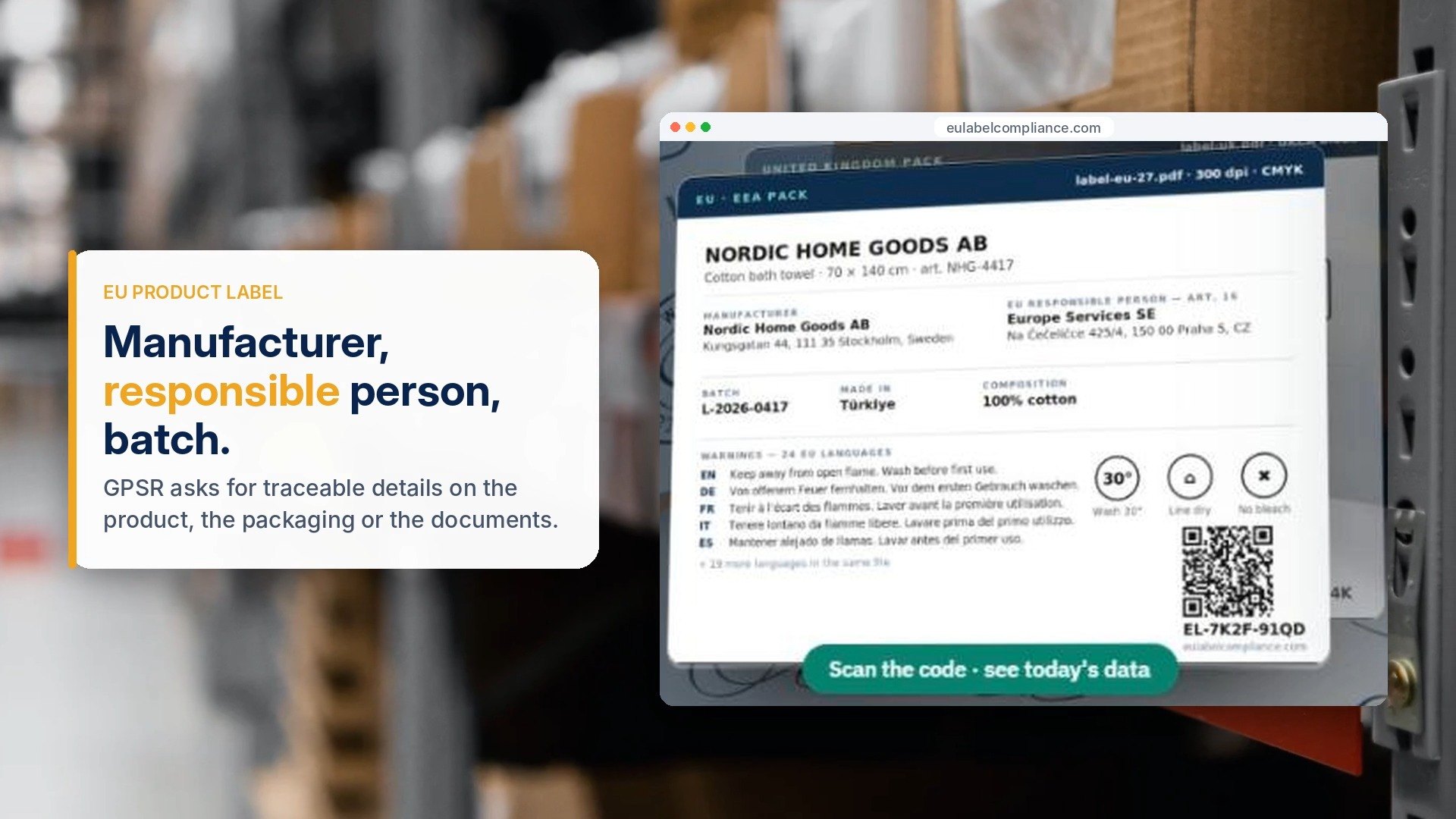
Article 9 of Regulation (EU) 2023/988 sets out the information an economic operator must make available on a product placed on the EU market. The mandatory blocks are:
- The manufacturer's name and postal address
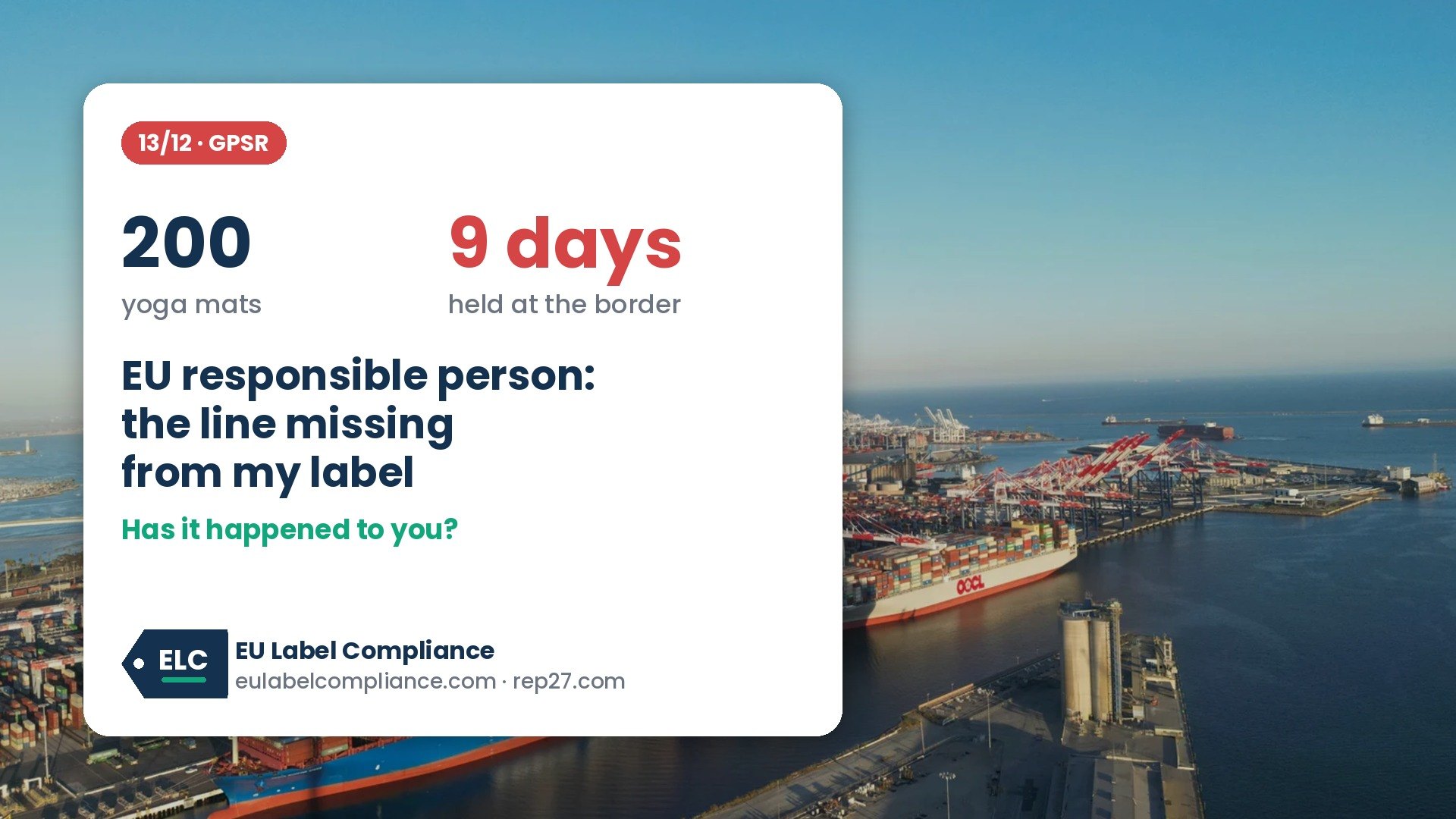
- The EU responsible person's name and postal address (required separately under article 16 of the same regulation and article 4 of Regulation (EU) 2019/1020 for CE-marked categories)
- A type, batch or serial number that identifies the product
- Warnings and safety information in a language consumers in each member state of sale can understand
All of this must be printed and legible. A data carrier — QR code, barcode, NFC chip — may sit alongside this text, but it does not substitute for any part of it.
Where the information goes on a small product
Some products are physically too small to carry all mandatory blocks directly on their surface. The regulation allows for this: when the product itself cannot accommodate the information, it may appear on the packaging or on an accompanying document such as a leaflet. Both routes are valid; both still require the text to be present, printed and readable — not hidden behind a scan.
Why marketplace reviewers flag QR-only labels
Amazon, Etsy, TikTok Shop, Temu and Shein all run compliance checks that look for the responsible person's name and address in the listing and on the product. A label carrying only a QR code gives a reviewer nothing to verify at a glance. Listings are suspended faster than any market surveillance authority moves, and reinstating them requires the corrected label documentation to be in place first.
What a compliant GPSR label contains in practice
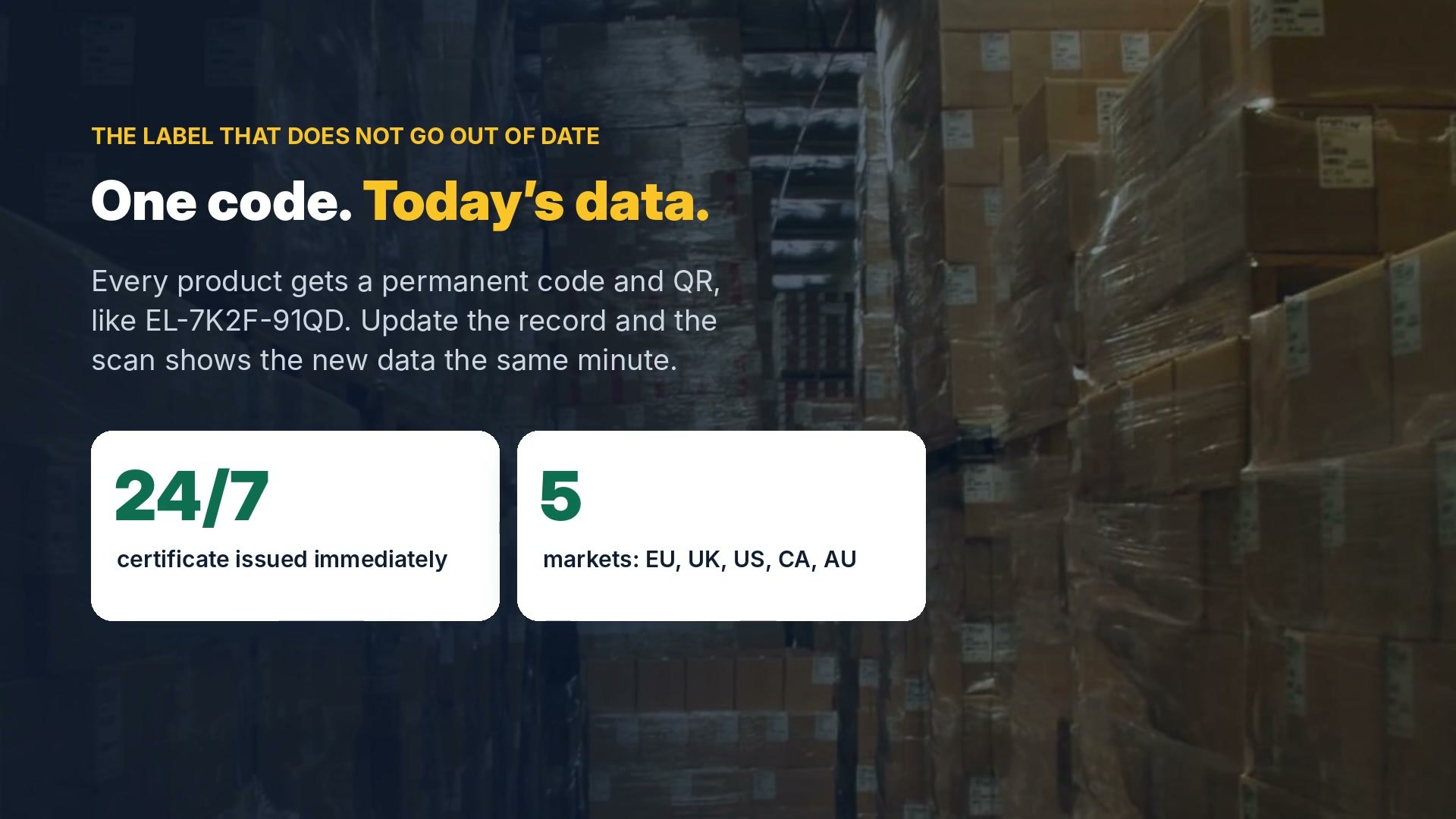
A label that satisfies the regulation carries the manufacturer block, the EU responsible person block with a Union address, the product identifier, and the required warnings — all in printed text at a size that is legible. A QR code pointing to a permanent public record for the product can sit beside that text and adds traceability, but the printed blocks are not optional.
For sellers with many SKUs or multiple markets, the practical step is to audit existing labels against the mandatory blocks before the next print run. Labels already in circulation that carry only a QR code or only partial information do not meet the GPSR requirement and expose the seller to corrective action by national market surveillance authorities, with penalties that in several member states reach a percentage of annual turnover.
Key points
- Under Regulation (EU) 2023/988, a QR code may complement a GPSR label but cannot replace any mandatory printed information.
- Every product sold in the EU must carry the manufacturer's name and postal address, the EU responsible person's details, a product identifier, and safety warnings in a language consumers understand.
- When a product is too small for the full label, the information moves to the packaging or an accompanying document — not behind a QR scan.
- Marketplace platforms check for the responsible person's name and address in the listing and on the product; a QR-only label gives reviewers nothing to read and leads to listing suspension.
- The EU responsible person requirement comes from two regulations: article 16 of Regulation (EU) 2023/988 and article 4 of Regulation (EU) 2019/1020.
Frequently asked questions
Can a QR code replace printed text on a GPSR label?
No. Under Regulation (EU) 2023/988, a data carrier such as a QR code may complement the mandatory label information but cannot replace it. The manufacturer name and address, the EU responsible person, the product identifier and safety warnings must all appear as printed, legible text.
What information is mandatory on a product label sold in the EU?
The manufacturer's name and postal address, the EU responsible person's name and address, a type, batch or serial number identifying the product, and safety warnings in the language of each country where the product is sold. Regulated categories such as CE-marked products add further marks on top of these basics.
Where does the label go if the product is too small to carry all the text?
The regulation allows the mandatory blocks to appear on the packaging or on an accompanying document such as a leaflet when the product surface cannot physically accommodate them. The information must still be printed and legible — it cannot be replaced by a QR code alone.
Which regulation requires an EU responsible person on the label?
Two regulations impose this. Article 16 of Regulation (EU) 2023/988 on general product safety, and article 4 of Regulation (EU) 2019/1020 on market surveillance for CE-marked categories. Both require an economic operator established in the Union to be named on the product, its packaging or an accompanying document.
Will Amazon accept a label that only has a QR code and no printed text?
No. Amazon and other marketplaces check that the responsible person's name and address appear in the listing and on the product. A QR-only label gives a reviewer nothing to verify, and listings are typically suspended until a corrected label with all mandatory printed blocks is in place.