 EU Label Compliance
Regulation (EU) 2023/988 on general product safety came into force on 13 December 2024. It replaced the old General Product Safety Directive and extended the labelling obligations to every economic operator—manufacturer, importer, distributor, fulfilment service provider—regardless of company size or production method.
If you sell a physical consumer product into the EU, the regulation covers you. There is no turnover threshold, no employee count below which the rules stop applying, and no category called 'handmade' that sits outside them.
Does GPSR apply to one-person workshops and craft sellers?
Yes. The regulation is triggered by the act of placing a product on the EU market, not by the scale of the operation. A solo candle maker selling through Etsy.de, a knitter listing on amazon.fr, or a ceramicist shipping from the US to buyers in Italy all fall within scope if the product is a consumer good and the destination is the EU or EEA.
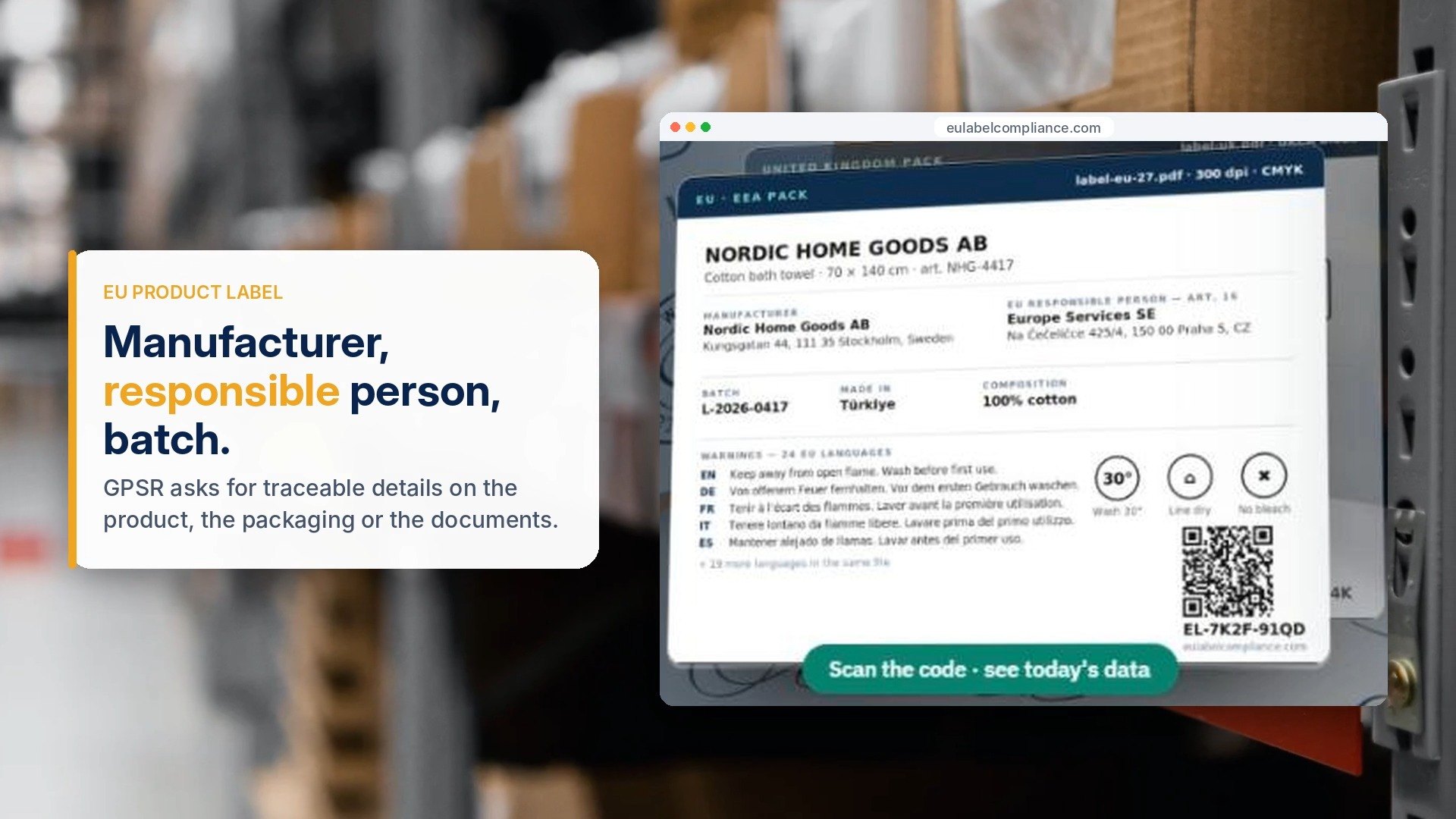
The label must carry the manufacturer's name and postal address, the name and address of an EU responsible person established in the Union (required under both Article 16 of Regulation 2023/988 and Article 4 of Regulation 2019/1020 for CE-marked goods), a product identifier such as a batch or type number, and the safety warnings in the language of each member state where you sell.
What about old stock already in the EU?
Products that were already on the EU market before 13 December 2024 can continue to be sold through to the end of the supply chain without relabelling. Products entering the market from that date onward—including new production runs, new shipments, and new listings going live after that date—must meet the current requirements.
This means a seller clearing existing warehouse stock is not automatically in breach. A seller manufacturing or importing new units is.
What the three common myths get wrong
- 'I'm too small for this to apply.' Size is not a criterion in Regulation 2023/988. The obligations attach to the product's journey to market, not to the seller's revenue or headcount.
- 'Handmade is exempt.' There is no handmade exemption in the regulation. A product made by one person in a workshop is a consumer product in the same sense as one made in a factory.
- 'All my old stock needs new labels.' Only partially true. Existing stock already circulating in the EU before 13 December 2024 is not caught by the new rules; new stock placed on the market after that date is.
What marketplaces check and what happens if the label is wrong
Amazon, Etsy, eBay and Temu run compliance checks that look for the mandatory label blocks—manufacturer address, EU responsible person, product identifier—and for confirmation that a responsible person with an EU address is named in the listing. A listing that fails the check is suspended; the timeline is typically faster than any market surveillance authority would move.
For products that do pass into the market without compliant labelling, national authorities can order corrective action, withdrawal or recall. Penalties are set by each member state and in several reach a percentage of annual turnover.
The practical fix is the same whether you make ten units a month or ten thousand: get the mandatory blocks on the label, name your EU responsible person, and keep a record that shows what data was on the label and when.
Key points
- Regulation (EU) 2023/988 applies from 13 December 2024 to every seller placing consumer goods on the EU market, with no size or revenue threshold.
- There is no exemption for handmade or craft products; the obligation is triggered by placing a product on the EU market, not by production method.
- Stock already on the EU market before 13 December 2024 can be sold through; new stock entering the market from that date must carry the compliant label blocks.
- Every compliant EU label must include the manufacturer's name and address, the name and address of an EU responsible person, a product identifier, and safety warnings in the language of each country of sale.
- Marketplace suspensions for missing label blocks happen faster than regulatory enforcement; the label is the first line of protection for a listing.
Frequently asked questions
Does GPSR apply to handmade products sold on Etsy or eBay?
Yes. Regulation (EU) 2023/988 contains no exemption for handmade goods. Any consumer product placed on the EU market from 13 December 2024 must carry the mandatory label blocks, regardless of how or where it was made.
What information must appear on a product label to comply with GPSR?
The manufacturer's name and postal address, the name and address of an EU responsible person established in the Union, a product identifier (type, batch or serial number), and safety warnings in the official language of every EU member state where the product is sold.
Do I need to relabel stock that was already in the EU before 13 December 2024?
No. Products already on the EU market before that date can continue to be sold without relabelling. Products placed on the market from 13 December 2024 onward must meet the requirements of Regulation (EU) 2023/988.
Which regulation requires an EU responsible person on the label?
Two regulations. Article 16 of Regulation (EU) 2023/988 on general product safety, and Article 4 of Regulation (EU) 2019/1020 on market surveillance for CE-marked products. Both require an economic operator established in the Union to be named on the product, its packaging or an accompanying document.
Can a small business or sole trader be suspended on Amazon for a missing GPSR label?
Yes. Amazon and other marketplaces check listings for the mandatory blocks—manufacturer address, EU responsible person, product identifier—and suspend listings that fail. This typically happens faster than any national market surveillance authority would act.