How we work
Everything on this site compressed into the order a real check happens in. Run it before the print run, not after the container sails.
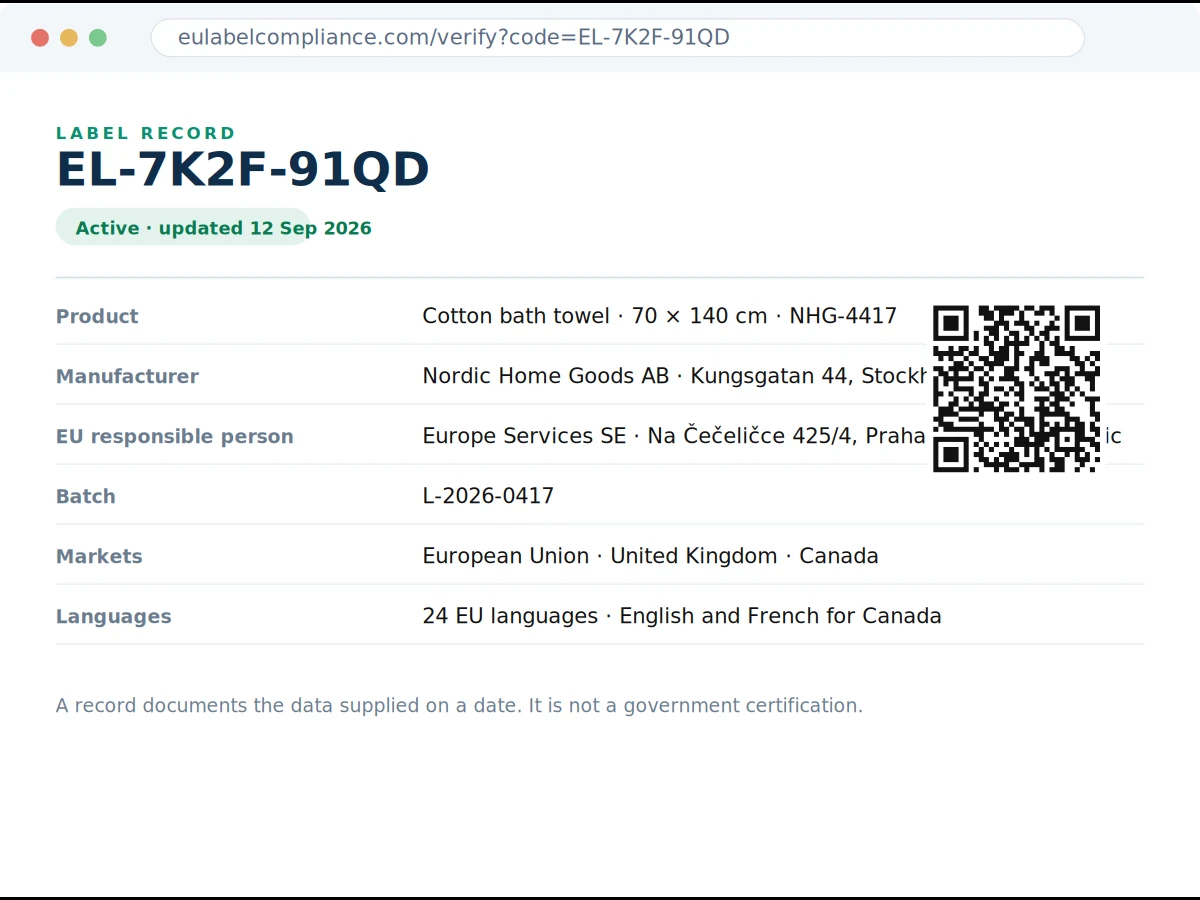
Know which markets the product is actually sold in, not which ones you hope for. Each market is a rule set, and the cheapest mistake is producing artwork for one and shipping to three.
Know your category. Toys, electricals and cosmetics each add blocks that a general layout does not have.
1. Manufacturer's legal name and full postal address, not a trade mark alone.
2. An operator established in the market: EU responsible person, UK representative, US distributor, Canadian dealer, Australian supplier.
3. A type, batch or serial number that identifies the production run.
4. Warnings and safety information in every required language, in settled legal wording.
5. Category marks in the right proportions: CE, UKCA, crossed-out bin, age warning, care symbols, Prop 65.
6. Net quantity and units where the market prescribes them, metric first in Canada and Australia.
7. Legibility: minimum x-height, contrast, permanence on the real substrate.
8. A proof printed at 1:1 and read on paper before the run.
Keep the declaration of conformity and the technical file where the named operator can reach them. Keep a copy of the artwork with its date. Update the record the day an address or a warning changes, so the labels already printed stay accurate.
Fix the record first, reissue the artwork, then decide about the stock. Relabelling is cheap compared with a withdrawal, and an authority treats a seller who corrected quickly very differently from one who argued.
A cotton bath towel made in Türkiye, sold on Amazon in Germany, France and Italy, plus a shop in the United Kingdom. Two markets, two packs.
EU pack: manufacturer block, EU responsible person, batch, fibre composition sewn in, care symbols, warnings in 24 languages on the packaging, permanent code. UK pack: UK operator with a British address, English text, same composition and care, same code.
Total artwork: two layouts plus a sewn-in tag. One product record behind both, so the manufacturer block is identical and a correction reaches all of them.
You supply the product data and the conformity documents. We build the artwork and hold the public record. Your printer prints. Your named operator answers authorities.
The failure mode we see most is nobody owning the third step: artwork approved, never printed on the right substrate, and a warehouse full of stock with a label that peels.
Diary the day the operator's mandate ends and the day the technical file needs review. Update the record the same day an address changes. Keep the dated artwork with the batch records so you can say which label went on which run.
| Step | Owner | Evidence to keep |
|---|---|---|
| Confirm markets and category | You | Written note in the file |
| Supply product and company data | You | Registration documents |
| Build artwork and record | Us | Dated files and the code |
| Approve the 1:1 proof | You | Signed proof |
| Print and apply | Your printer | Substrate spec and run date |
| Answer authorities | Named operator | Correspondence and deadlines |
The same information, in the order an inspector or a reviewer meets it.
The certificate and the permanent code are immediate; the print-ready artwork follows within a few working hours.
Then you cannot label the product honestly, and that is a supplier problem before it is a labelling one. We will tell you rather than inventing a line.
Yes. Send the artwork or a photograph and we say what is missing, block by block.
Unlimited. Plans count markets, not SKUs.
We can tell you what blocks it carries. We do not write opinions about other companies' compliance.
You still buy one market: the EU counts as one, so a seller in Germany alone pays the same as one selling in all 27.
Print-ready artwork for the markets you sell in, a permanent code with a public record, and a free reissue whenever your details change. Seven days free, no card.
 EU Label Compliance