United States
American labelling is federal, fragmented and old. Three requirements do most of the work, and getting them wrong is what stops a container at the port rather than at the shelf.
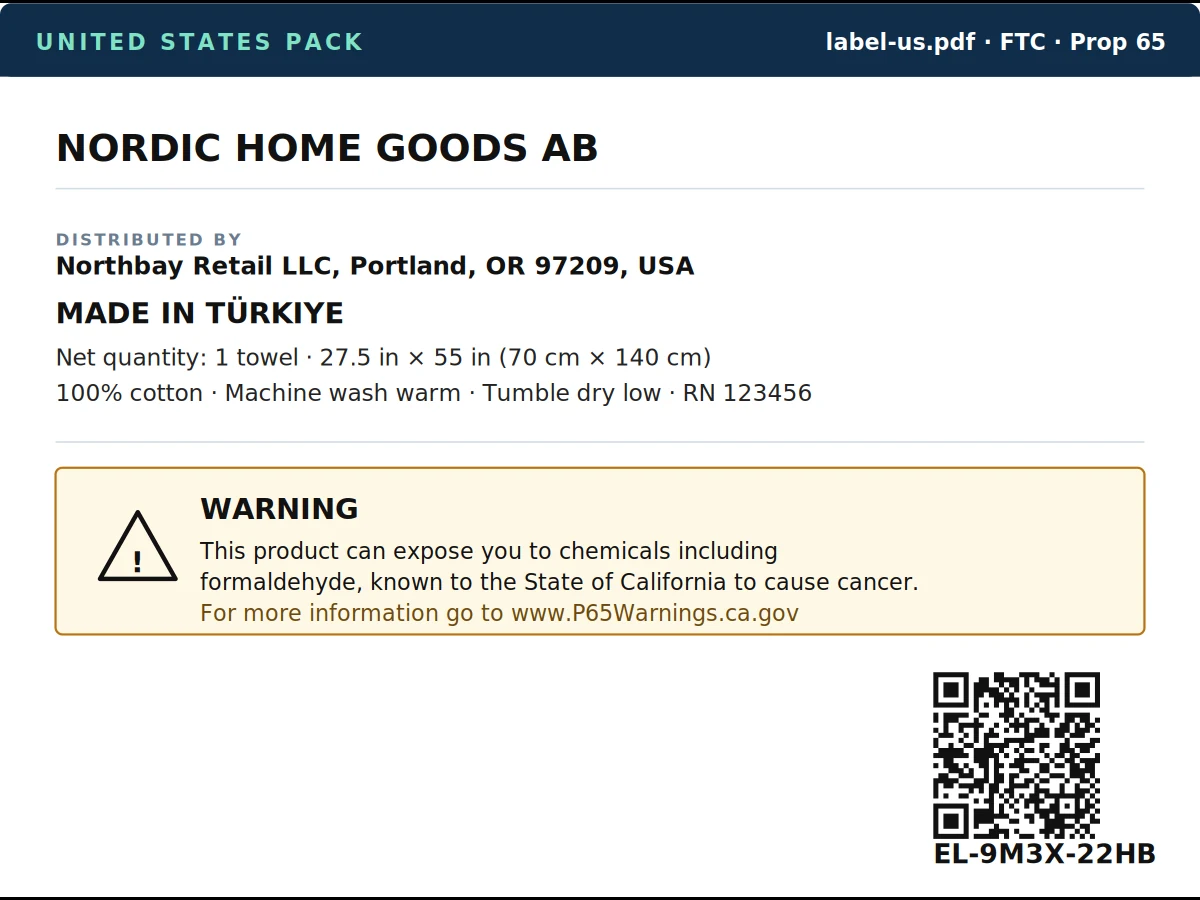
Every article of foreign origin imported into the United States must be marked conspicuously, legibly and permanently with the English name of the country of origin. 'Made in Türkiye' is a marking; a flag or a three-letter code is not.
The marking follows the article, not the carton. If the ultimate purchaser sees the retail box, the box carries it too.
The Fair Packaging and Labeling Act asks for the name and place of business of the manufacturer, packer or distributor on the principal display panel. A distributor must say so — 'Distributed by' — rather than implying manufacture.
This is the block foreign sellers most often leave out, because in the EU the equivalent is the responsible person and they assume one covers the other. It does not.
Net contents are declared in both US customary and metric units, in a defined position and type size on the principal display panel. Rounding one of the two figures to something friendlier is a violation, not a design choice.
Textile products add fibre content by weight in descending order, the country where the product was processed or manufactured, and the identity of the responsible company — often as an RN number. Care instructions follow the Care Labeling Rule and must be permanent.
Proposition 65 is a state law with national reach, because most sellers cannot separate Californian stock. Where a listed substance is present above the safe harbour level, a specific warning with a defined symbol and wording is required. We place it when you tell us it applies; we do not test the product to find out.
Marking must be legible, indelible and permanent enough to reach the ultimate purchaser. Customs looks at the article first and the container second, and applies the J-list and the substantial transformation rules to decide what the country of origin actually is.
Assembly abroad from American components does not automatically make the product American, and a final screw turned in one country does not erase the origin of the whole. The test is whether a new article with a different name, character or use emerged.
Special marking rules apply to a list of articles — pipe fittings, manhole covers, knives, watches — where the mark must be die-stamped, cast or engraved rather than printed.
A product advertised as Made in USA must be all or virtually all made in the United States. The FTC enforces this actively, with civil penalties since 2021, and qualified claims such as 'Assembled in USA from imported parts' exist precisely for the middle ground.
If your listing says American and your label says Türkiye, the listing is the problem, not the label.
Federal marking rules apply to the goods; the platform rules apply to the listing. Amazon asks for country of origin and responsible party fields, and a mismatch between the field and the printed label is the most common automated flag.
| Requirement | Source | Where it appears |
|---|---|---|
| Country of origin | 19 U.S.C. 1304 | On the article, conspicuously |
| Identity of responsible party | Fair Packaging and Labeling Act | Principal display panel |
| Net quantity, dual units | FPLA and state weights rules | Principal display panel, defined type size |
| Fibre content and care | Textile Act and Care Labeling Rule | Permanent label in the garment |
| Prop 65 warning | California Health and Safety Code | Label or listing, clear and reasonable |
The same information, in the order an inspector or a reviewer meets it.
Not for labelling. You need an identifiable responsible party with a US place of business, which is usually your importer or distributor.
No, but for textiles it is a convenient way to satisfy the identity requirement without printing a long company name.
No. It applies when a listed chemical is present and exposure exceeds the safe harbour level, or where your supplier declares one.
Yes if permanent enough to reach the purchaser, but several articles on the special list require die-stamping or casting.
Yes on the principal display panel for packaged consumer commodities.
You are, and your place of business appears on the panel with 'Distributed by' or 'Manufactured for'.
Print-ready artwork for the markets you sell in, a permanent code with a public record, and a free reissue whenever your details change. Seven days free, no card.
 EU Label Compliance