Australia and New Zealand
Australia regulates by category and by claim. The common thread is that a consumer, and the ACCC, must be able to find out instantly who put the product on the market.
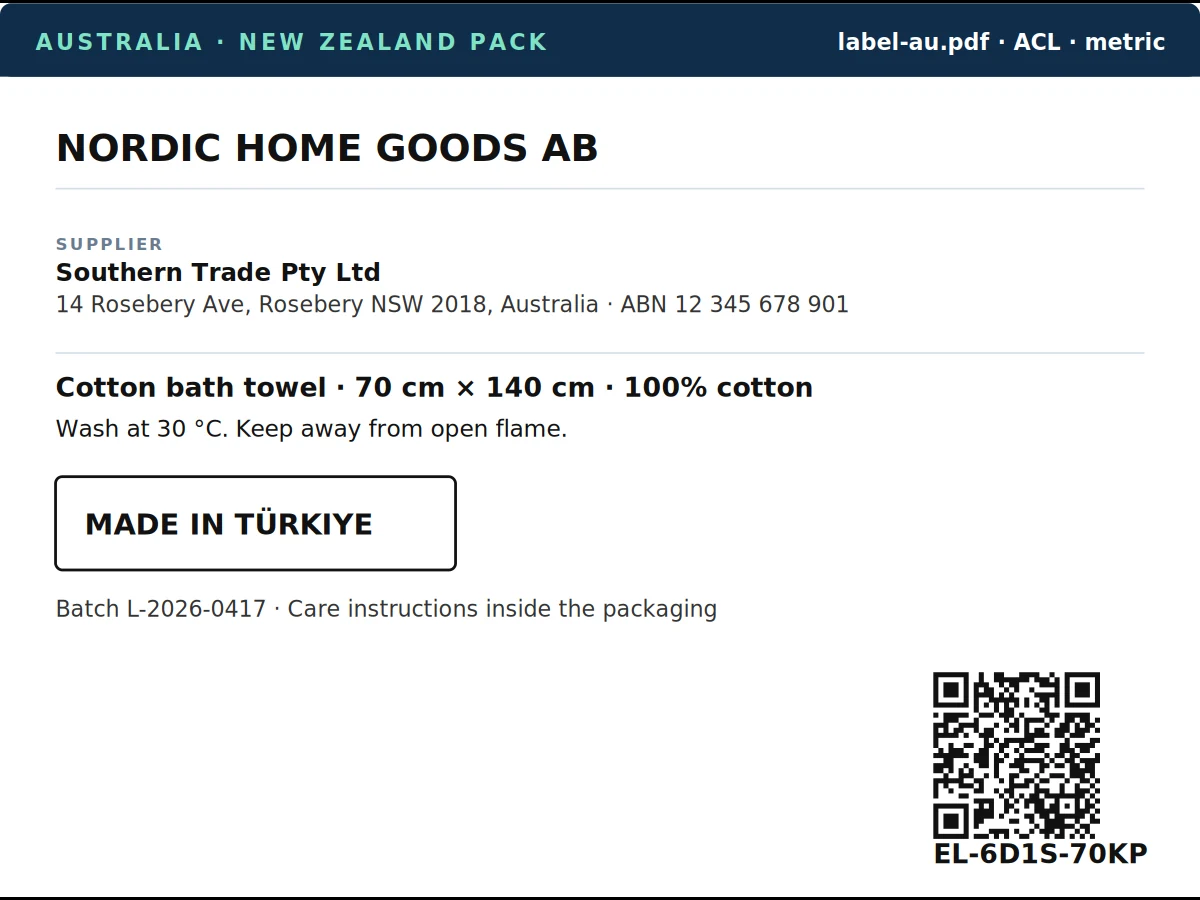
The supplier — importer, manufacturer or distributor — must be identifiable, with a street address in Australia. A PO box is not an address, and an ABN alone is not identification.
Where a mandatory standard applies to the category, the standard itself usually prescribes additional markings, and those take precedence over a general layout.
Country of origin claims are regulated under the Australian Consumer Law, and the safe harbour defences depend on the wording used. 'Made in', 'Product of' and 'Assembled in' are not interchangeable: each has a legal meaning tied to substantial transformation and cost of production.
Packaged goods sold by measure follow the National Measurement rules: the measurement marking appears on the principal display panel, in prescribed units, with a minimum character height depending on the quantity.
New Zealand runs parallel rules under the Fair Trading Act with its own consumer information standards, notably for textiles and footwear. A single trans-Tasman label is usually possible, and we build it from the same record rather than as a second job.
The Australian Consumer Law works through mandatory standards and bans for specific goods: children's nightwear, toys for children under three, bicycles, prams, cosmetics ingredient labelling and others. Each standard prescribes its own markings.
A general layout that satisfies supplier identity and origin will still fail if the category standard asks for a fire-hazard label or a specific warning and it is absent.
Penalties under the ACL are substantial and the ACCC publishes enforcement outcomes, which is part of the cost.
Australia distinguishes 'Made in', 'Product of' and 'Grown in', each with its own test. The safe harbour defences depend on substantial transformation and, for some claims, the proportion of production costs incurred in the country.
The kangaroo logo belongs to a certification scheme and cannot be used without membership.
Cosmetics sold in Australia carry an ingredient list following the standard, in descending order, with permitted variations for small containers. It is close enough to INCI to reuse the EU list in most cases, and different enough to check.
| Element | Requirement |
|---|---|
| Supplier identity | Name and street address in Australia |
| Country of origin | Wording matched to the legal test used |
| Measurement marking | Prescribed units, position and character height |
| Category markings | Whatever the mandatory standard prescribes |
| Language | English |
The same information, in the order an inspector or a reviewer meets it.
Not for labelling, but the supplier identified must have an Australian street address — normally your importer.
Yes. Australia and New Zealand do not require a second language.
They are a separate regime with their own marks and registration. A label does not replace an approval, and we say so before you order.
No. A name and street address are needed; the ABN is useful but not sufficient.
Usually, with its own consumer information standards for textiles and footwear.
For electrical goods yes, and it is separate from labelling.
Print-ready artwork for the markets you sell in, a permanent code with a public record, and a free reissue whenever your details change. Seven days free, no card.
 EU Label Compliance