How we work
A label can carry every mandatory block and still fail, because the text is too small, the contrast too low or the file the printer received was a screenshot.
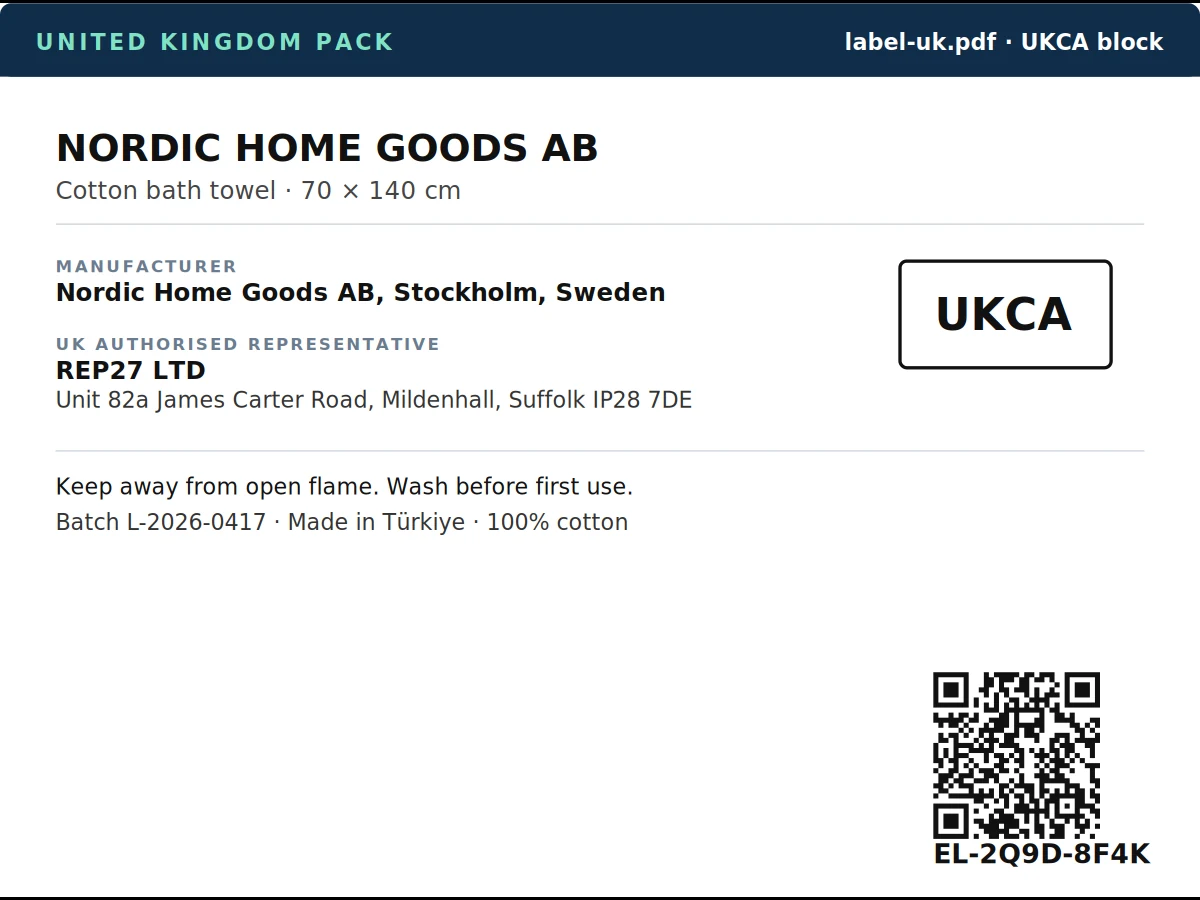
A print-ready PDF at 300 dpi in CMYK with 3 mm bleed and crop marks. An SVG with live text and vector pictograms, so a local studio can adjust without redrawing. A 1:1 PNG proof for approvals and for marketplace evidence.
If your printer wants a different colour profile, a die-line or a spot colour, send it and we match it rather than asking you to adapt.
There is no single millimetre figure across every category, but the information must be legible and indelible. We set safety text at a minimum of 1.2 mm x-height and never below, keep contrast above the level where thermal printing starts to close letters, and avoid reversed-out text for anything mandatory.
Category rules override this where they are stricter — net quantity on Canadian packaging, measurement marking in Australia, the type sizes in the US display panel rules.
Indelible means it survives normal use. A thermal receipt label on a product that spends a summer in a car is not indelible, and neither is an inkjet print on uncoated paper sewn into a garment. We flag the mismatch when the category and the substrate you name cannot work together.
Print the 1:1 proof on paper, at the real size, and read the smallest line at arm's length. Two minutes there prevents the expensive discovery at the port.
Thermal transfer on synthetic film holds fine text and survives moisture. Direct thermal fades in heat and light and is unsuitable for anything that must remain legible for the life of the product. Uncoated paper wicks ink and closes small counters.
Fabric labels lose about a size step to the weave, so a 1.2 mm x-height on paper becomes marginal on woven polyester and we set it larger.
Curved surfaces and shrink sleeves distort type and codes; artwork for them is drawn pre-distorted or the code fails.
Mandatory text in a light grey on white passes a screen review and fails on press. We keep mandatory blocks at full contrast and never reversed out unless the substrate justifies it.
Spot colours are matched where you supply them; otherwise we stay within a CMYK build that survives a four-colour run without registration surprises on small type.
The batch field is a defined zone with its own clearance, so a line printer or an inkjet head can fill it without overprinting anything mandatory. Where you print batches in house, we supply the zone coordinates.
| File | Format | Use |
|---|---|---|
| Print PDF | 300 dpi, CMYK, 3 mm bleed, crop marks | The print run |
| Vector SVG | Live text, vector pictograms | Local adjustments |
| Proof PNG | 1:1 at real size | Approvals and marketplace evidence |
| Zone map | Coordinates of the batch field | In-house variable printing |
The same information, in the order an inspector or a reviewer meets it.
Yes, and most clients want that. Send the file or a photograph and we rebuild the compliant version inside your own design.
We match the die-line your printer supplies. We do not invent structural packaging.
The batch field is laid out as a variable zone so your printer or your line can fill it per run.
Yes, send the reference and the substrate and we build to it.
We supply outlined vectors, so no licence travels with the file.
We export from the same vector master on request.
Print-ready artwork for the markets you sell in, a permanent code with a public record, and a free reissue whenever your details change. Seven days free, no card.
 EU Label Compliance