European Union
The General Product Safety Regulation applies to almost every non-food consumer product on the EU market. Most of it is about what you must be able to prove. A small, stubborn part is about what must be printed on the thing itself.
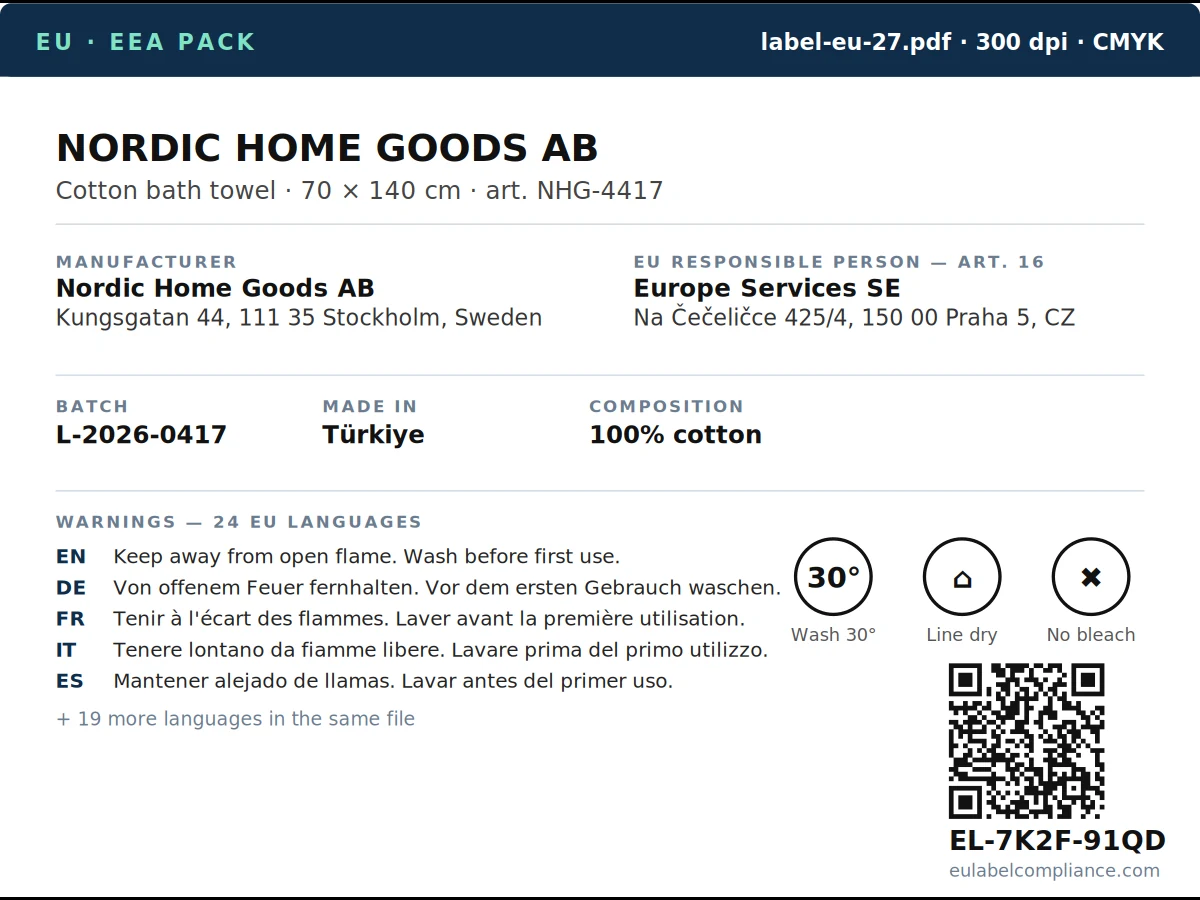
Article 9 requires the manufacturer's name, registered trade name or trade mark and postal address on the product, or on its packaging, or on a document accompanying it. A website is not an address.
Article 9 also requires a type, batch or serial number that identifies the product. One number for an entire catalogue does not identify anything: it has to narrow the goods down to a production run.
Article 16 adds the economic operator established in the Union — the responsible person — with their own name and postal address. For goods coming from outside the EU this is the block that stops the shipment when it is missing.
Finally, warnings and safety information in a language consumers understand in each country of sale. Which language counts is decided by each member state, not by the seller, which is why we put all 24 on the artwork.
The rule is a hierarchy, not a choice. First the product. If size or the nature of the product makes that impossible, the packaging. If that is impossible too, an accompanying document. Skipping straight to the leaflet because it is cheaper is the most common finding in a market surveillance report.
On very small items we produce two versions in the same order: a reduced on-product mark carrying identity and batch, and a full packaging layout carrying the warnings and pictograms.
A trade mark instead of a legal name. A logo is not a registered trade name unless it is registered as one.
A responsible person named without an address, or with an address that is a mailbox in a country where nobody answers.
Warnings translated by machine, where 'keep away from open flame' becomes something that means nothing in Polish.
Text under the legible threshold, printed at 0.8 mm because the layout was designed before the blocks were known.
A QR code replacing printed text. Under the GPSR a data carrier can complement the mandatory information, never replace it.
Print-ready artwork with every block in place, the warnings typeset in all 24 official EU languages, pictograms drawn as vectors, and a 1:1 proof so you can check it on paper before the print run.
Each product also gets a permanent code with a public record, so when your address or a warning changes, the labels already printed keep pointing at the right information.
The manufacturer is whoever makes the product, or has it made and markets it under their own name or trade mark. A seller who puts their brand on goods produced by a Chinese factory is the manufacturer in the eyes of the regulation, whatever the contract says internally.
That matters on the label, because the block has to name that company, not the factory. It also matters afterwards: the obligations that follow the name — technical documentation, corrective action, cooperation with authorities — follow it too.
Where a distributor modifies a product, repackages it or changes its intended use, the distributor becomes the manufacturer for that product. Relabelling somebody else's goods is not a neutral act.
A market surveillance officer rarely starts with a laboratory. They photograph the label, check the blocks, ask for the declaration of conformity and the technical file, and write down how long the answer took.
A label that carries every block buys time and credibility. A label missing the responsible person turns a routine check into a file, because the officer now has nobody established in the Union to write to.
Most national authorities publish their findings. A withdrawal notice with your brand on it outlives the stock it concerned.
Article 19 requires the offer itself to show the manufacturer's details, the responsible person, a product identifier and any warnings, before the consumer buys. The label in the box is too late for that purpose.
This is why our artwork is designed to be photographed: one image proves the blocks, and the same text is supplied for the marketplace fields, so the listing and the print agree.
| Information | On the product | On the packaging | In a document |
|---|---|---|---|
| Manufacturer name and address | Required first | If the product cannot carry it | Last resort only |
| EU responsible person | Required first | Accepted | Accepted |
| Type, batch or serial number | Required | If impossible on the product | Not accepted alone |
| Warnings and safety information | Where they affect use | Required | Instructions may carry the detail |
| Pictograms and category marks | Per category rules | Per category rules | Not accepted alone |
The same information, in the order an inspector or a reviewer meets it.
Often yes. Used, repaired and reconditioned products placed on the EU market are covered, with limited exceptions for antiques and items clearly sold to be repaired.
No. The regulation asks for a postal address. A URL or an email address alone does not satisfy article 9 or article 16.
Yes, if the mandate is in place for each of them and each product names that operator on the label.
Only if it is the registered trade name. A logo that is not registered as a trade name does not identify the company.
Yes. An importer established in the Union is one of the operators that can take the role, and is the most common choice.
Then the blocks go on the product, in a reduced layout if necessary, and the warnings travel with it in the instructions.
Print-ready artwork for the markets you sell in, a permanent code with a public record, and a free reissue whenever your details change. Seven days free, no card.
 EU Label Compliance