By category
Toys are the category where a label error becomes a recall fastest, because the rules are specific and the enforcement is active.
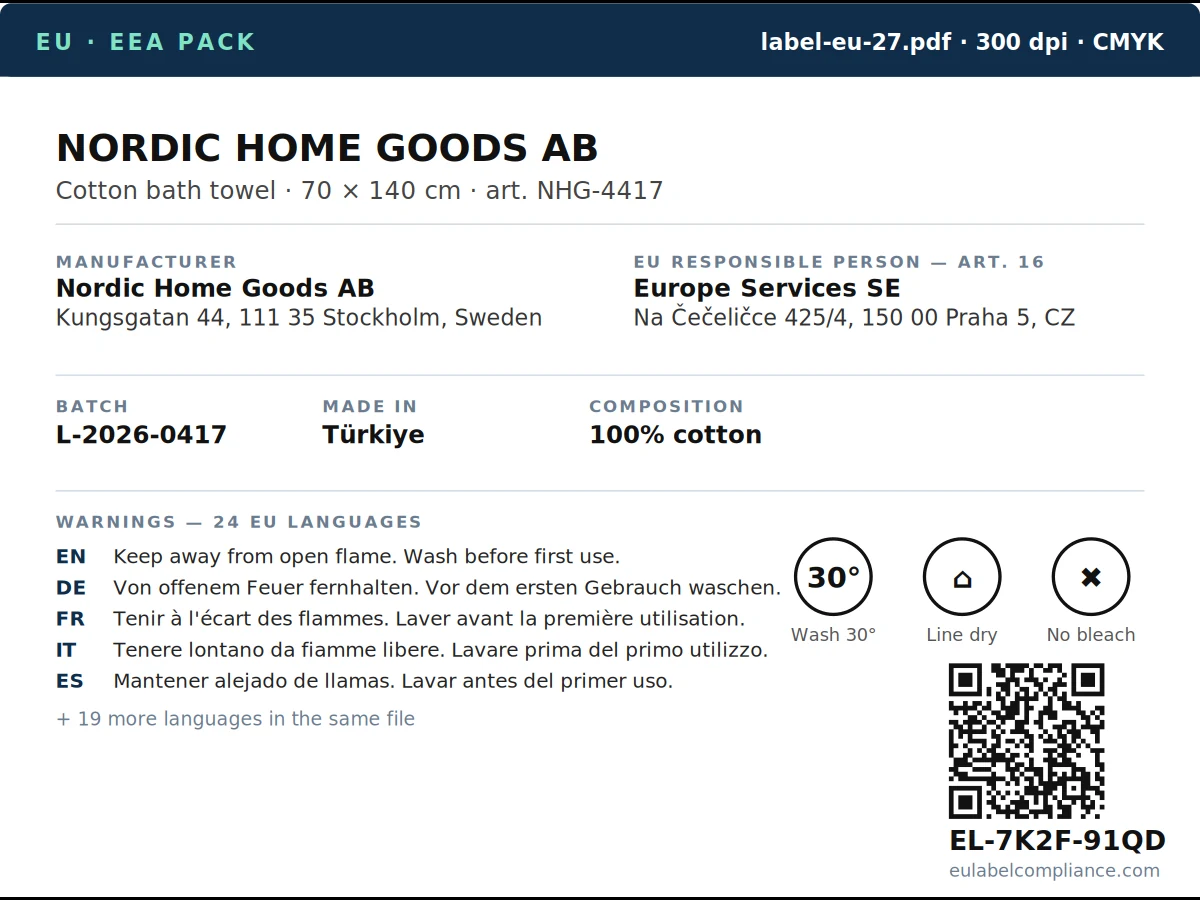
The CE marking goes on the toy, on an affixed label or on the packaging, visible, legible and indelible. Behind it there must be an EU declaration of conformity and a technical file.
Type, batch, serial or model number must identify the toy, together with the manufacturer's name and address and the importer's or responsible person's details.
The 0-3 warning — a crossed-out face over the age range, with the reason for the restriction — is required for toys not suitable for children under three. The reason matters: 'small parts' is not optional decoration.
Other categories add their own prescribed wording: aquatic toys, functional toys, chemical sets, scooters and skates, projectile toys.
Warnings that determine the decision to buy must be visible before purchase, including in online sales. A warning printed inside the box is not visible before purchase, and a marketplace listing must show it.
Artwork carrying the CE block, the age warning with the correct pictogram proportions, the prescribed category wording, the identity and traceability blocks, and the whole set translated into the languages of the markets you sell in.
The directive prescribes wording for several categories: aquatic toys, functional toys, chemical toys, activity toys, toys in food, scooters and skates, and imitations of protective masks. The wording is not a suggestion.
Each warning has to be preceded by the word 'Warning' and be visible, legible, accurate and understandable before purchase.
Where the warning determines the purchase — age restriction, supervision requirement — it must appear in the online offer too, not only on the box.
The pictogram shows a crossed-out face with the age range 0-3. Next to it the reason must appear: small parts, long cord, small ball, marble, and so on. The reason is what tells a parent why, and what an inspector checks.
The warning cannot be applied to a toy that is manifestly intended for children under three, as a way of avoiding the stricter requirements. Authorities treat that as a misuse.
Type, batch, series or model number goes on the toy where possible, otherwise on the packaging. For small toys sold in multipacks the number identifies the run, not the individual piece.
| Block | Where | Notes |
|---|---|---|
| CE marking | Toy, label or packaging | Visible, legible, indelible |
| Manufacturer name and address | Toy or packaging | Registered name |
| Importer or responsible person | Toy or packaging | EU address |
| Type or batch number | Toy where possible | Identifies the run |
| Age warning and reason | Visible before purchase | Prescribed pictogram |
| Category warnings | Visible before purchase | Prescribed wording |
The same information, in the order an inspector or a reviewer meets it.
Yes, in the language or languages the member state requires, which is why we ship all 24.
It can go on the toy, on an affixed label or on the packaging, but it must be visible to the consumer.
It is not mandatory to print the standard, and printing it without the testing behind it is a false claim.
To carry CE lawfully, you need evidence of conformity; test reports are the usual route.
Yes if permanent and visible before purchase, including online.
Toys for collectors over fourteen are excluded if labelled as such, and that label is itself regulated.
Print-ready artwork for the markets you sell in, a permanent code with a public record, and a free reissue whenever your details change. Seven days free, no card.
 EU Label Compliance