How we work
The regulation says the consumer must easily understand. It leaves the decision on which language that is to each member state, which is why the honest answer to 'which languages do I need' is usually 'more than you think'.
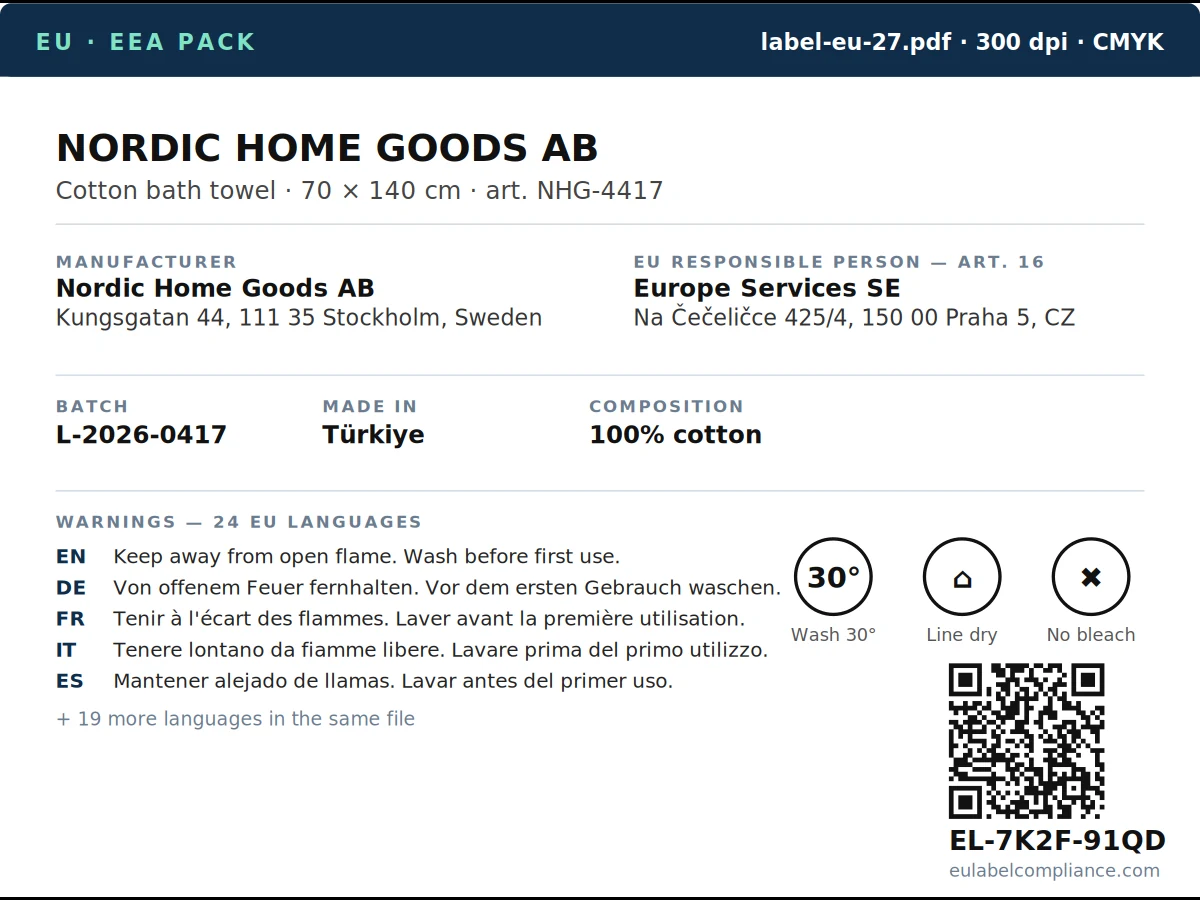
Each member state sets the language requirement for its own market. Several accept only their national language, some accept a neighbouring one, a few accept English for certain categories. The rule can also differ between the safety warnings and the instructions.
Rather than tracking twenty-seven moving targets, we put all 24 official languages on the artwork. The label survives you adding a market later without a reprint.
Warning text is legal text. 'Keep away from open flame' has a settled formulation in each language, and a machine rendering that is merely understandable reads as improvised to an inspector and to a consumer.
We use the settled formulations and typeset them, rather than pasting output and hoping the diacritics survive the print.
Warnings are grouped by language with a two-letter prefix, set at a minimum x-height, and ordered so that the languages of your declared markets come first. Where space genuinely runs out, the on-product mark carries the core blocks and the packaging or leaflet carries the full set.
Free. You update the record, we reissue the files, and the labels already printed keep working because the code on them points at the record rather than at a frozen file.
Some member states require their own language only. Some accept a second, usually for technical instructions rather than for safety warnings. A few accept English for professional products but not for consumer goods.
Because the requirement sits in national law rather than in the regulation, it changes without a European announcement. Carrying all 24 languages removes the need to watch twenty-seven legislatures.
Outside the EU the logic is different: Canada wants two languages by law, Australia one, the United States none but in practice English.
Diacritics decide legibility. Czech, Polish, Hungarian, Romanian and Lithuanian all carry marks that disappear at small sizes or in condensed faces, and a warning that cannot be read is not a warning.
We set warnings with adequate leading and never below the minimum x-height, and we avoid all-caps blocks in languages where capitals hide the diacritics.
Each safety phrase has a settled equivalent in each language, used across the sector. Changing it because a new translation sounds better creates a difference that an inspector notices.
We keep a fixed glossary per language and reuse it across your products, so your fifteenth label says the same thing as your first.
| Market | Languages on the label |
|---|---|
| European Union | National language of each country of sale; we supply all 24 |
| Norway, Iceland, Liechtenstein | National languages, covered by the EU pack |
| United Kingdom | English |
| Canada | English and French |
| United States | English in practice; Spanish common but optional |
| Australia and New Zealand | English |
The same information, in the order an inspector or a reviewer meets it.
For some categories in a few member states, yes. Relying on it across the Union is how listings get pulled.
No. We translate and typeset the mandatory safety text; brand copy stays yours.
They follow the EEA rules and their own languages; the EU pack covers them.
Instructions follow the same national requirement; most clients print the markets they sell in and keep the rest digital.
You can drop the ones you do not sell in, and add them later free of charge.
We do, against a fixed glossary, and you can have the file to check with your local team.
Print-ready artwork for the markets you sell in, a permanent code with a public record, and a free reissue whenever your details change. Seven days free, no card.
 EU Label Compliance