 EU Label Compliance
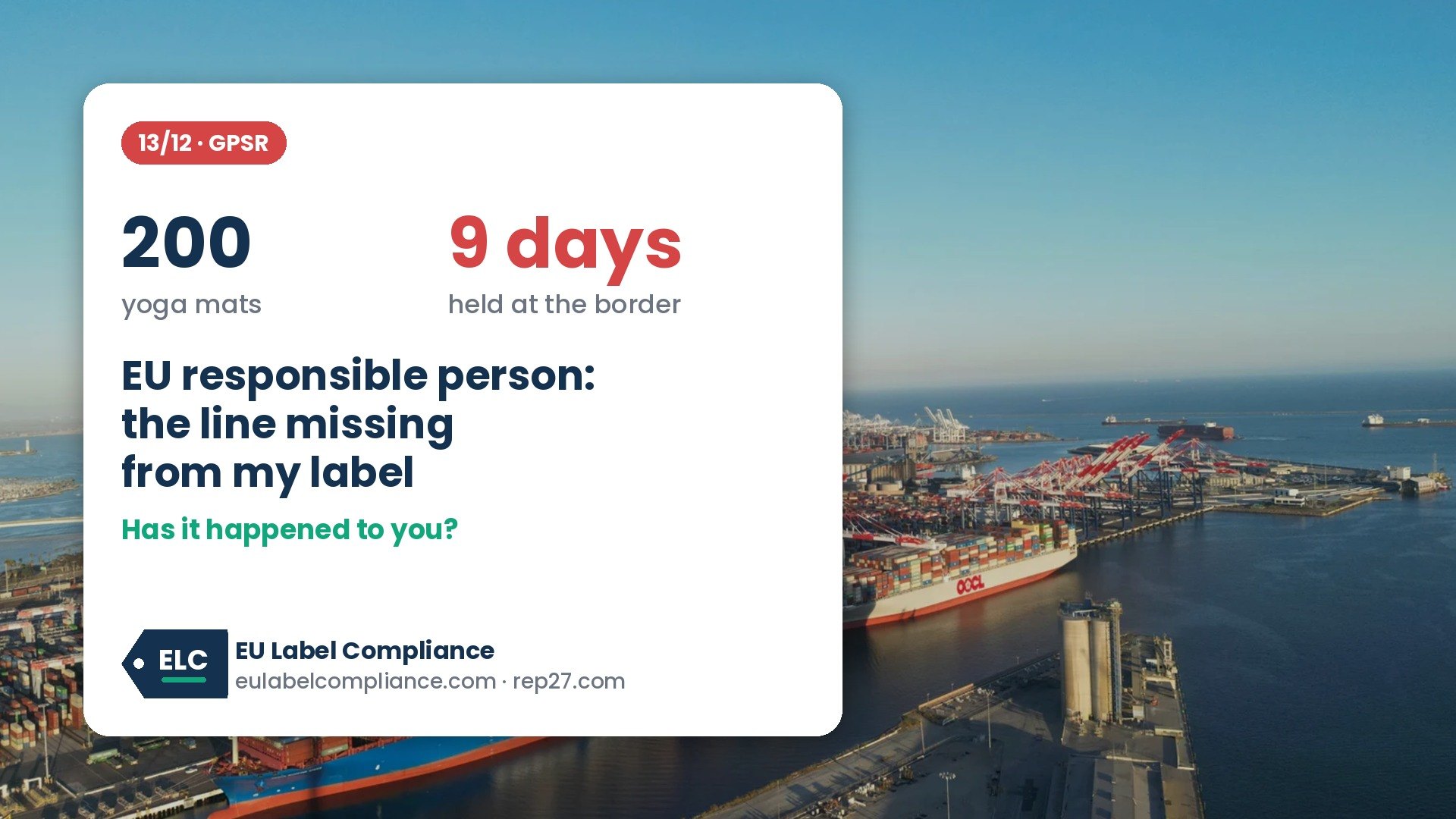
Regulation (EU) 2023/988 on general product safety came into force with a direct effect across all 27 EU member states. Article 9 sets out what information must appear on a product or its packaging; Article 16 requires that an economic operator established in the Union be named and reachable. For a seller based outside the EU — whether shipping from China, the United States or the United Kingdom — that means appointing an EU responsible person and printing their name and postal address on every product before it enters the market. Marketplace platforms including Amazon, Etsy and eBay now verify these details both in the listing and on the physical product.
What exactly must appear on the label under GPSR?
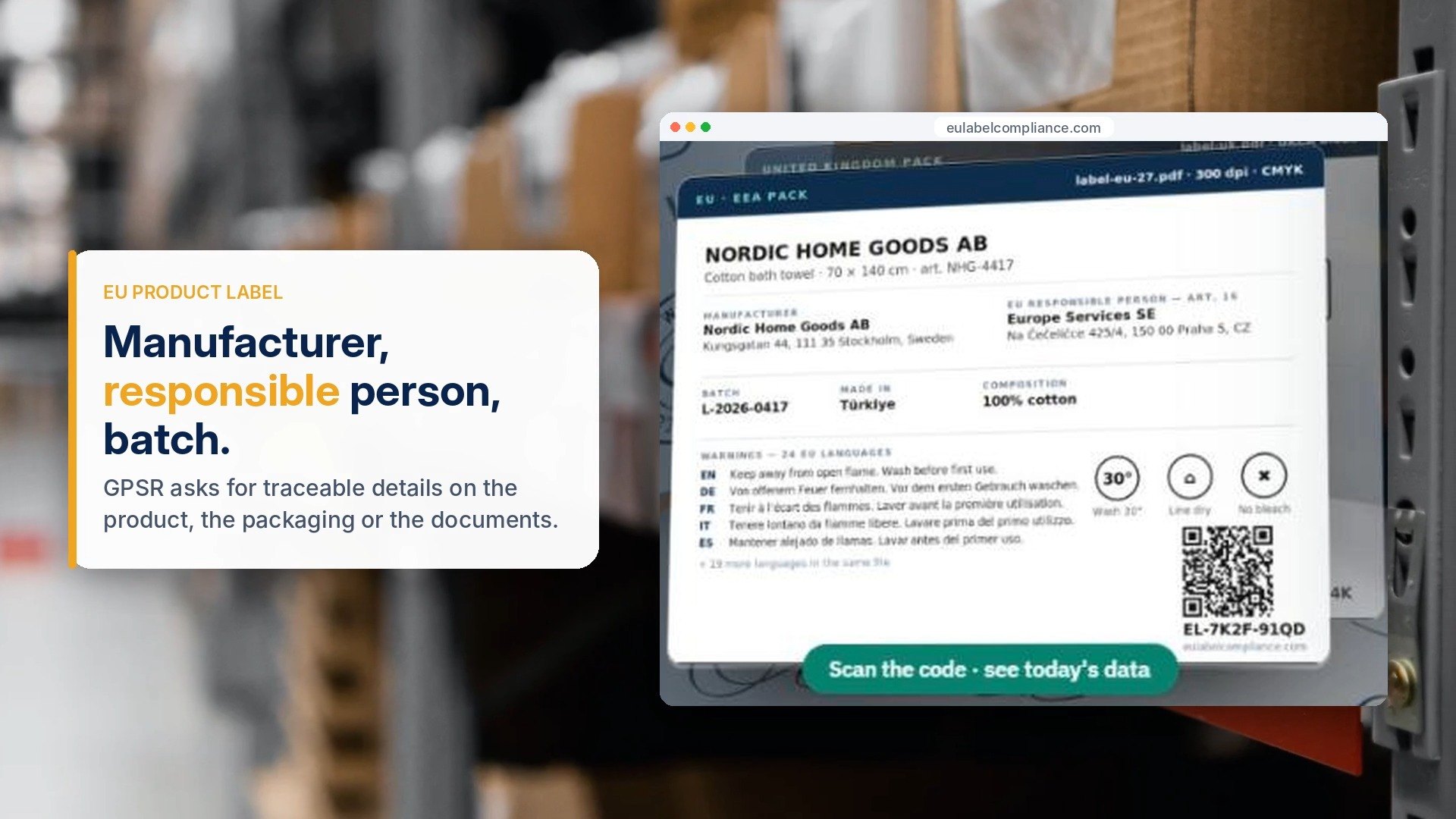
The minimum mandatory block under Art. 9 of Reg. (EU) 2023/988 contains four elements: the manufacturer's name and postal address; a type, batch or serial number that identifies the product; the name and address of the EU responsible person; and safety warnings in the official language of every country where the product is sold. For a seller active in Germany, France and Italy, the warnings must be present in German, French and Italian on the same label. A QR code can complement this information but cannot replace the printed text — the regulation is explicit on this point.
What files does a marketplace reviewer actually need to see?
Marketplace compliance teams typically ask for a label proof showing all mandatory blocks legible and correctly positioned, plus confirmation that an EU responsible person with a verifiable address is named. EU Label Compliance produces a print-ready PDF at 300 dpi in CMYK with 3 mm bleed and crop marks, an SVG with live editable text and vector pictograms, and a 1:1 PNG proof sized for on-screen approval. Each product also receives a permanent alphanumeric code — in the format EL-XXXX-XXXX — printed beside a QR on the label; the code resolves to a public record page holding the current product data, which an inspector or reviewer can check directly.
Which sellers are affected?
Any economic operator placing a consumer product on the EU market is in scope, regardless of the sales channel. That includes:
- Third-party sellers on Amazon.de, Amazon.fr, Amazon.it and other EU storefronts
- Etsy sellers shipping to EU buyers from outside the Union
- eBay sellers with active EU listings
- Sellers on Temu, Shein and TikTok Shop operating in the EU
The obligation follows the product, not the platform. A seller on a single marketplace shipping to five EU countries needs warnings in each of those countries' languages on the same label.
Pricing and what is included
Subscriptions run per market, with unlimited products on every plan. The EU with all EEA countries counts as one market at €290 per year. Three markets — for example, EU, UK and US — cost €590 per year; every market covered by the service costs €990 per year. The seven-day free trial requires no card, only a six-digit verification code sent to a company email address. The permanent product code and public record are issued immediately when payment clears; the print-ready artwork is delivered within a few working hours, the same day for orders placed before 15:00 CET.
The service does not include product testing, CE declarations of conformity, technical files or EPR registrations. It produces the label artwork and the permanent record. Those are separate obligations and the service description says so before you pay.
Key points
- Regulation (EU) 2023/988, Art. 9 and 16, requires the manufacturer's details, a product identifier, an EU responsible person and safety warnings in each country's language on every consumer product sold in the EU.
- Marketplace platforms check both the listing and the physical product for the mandatory label blocks; missing or incomplete information leads to listing suspension, not just a warning.
- A QR code can supplement printed mandatory information under the GPSR but cannot substitute for it — the text must be physically present and legible on the product or packaging.
- The EU plan at €290 per year covers all 27 member states plus Norway, Iceland and Liechtenstein with no per-product charge and label artwork in all 24 official EU languages.
- Each product receives a permanent alphanumeric code and QR linking to a live public record; updating the record after printing does not require reprinting, as the code continues to resolve to the current data.
Frequently asked questions
What must a GPSR-compliant product label show?
Under Art. 9 of Regulation (EU) 2023/988, the label must show the manufacturer's name and postal address, a type, batch or serial number, the name and address of an EU responsible person, and safety warnings in the official language of each EU country where the product is sold. These elements must be printed and legible; a QR code alone is not sufficient.
Do Amazon, Etsy and eBay sellers need an EU responsible person on their labels?
Yes. Article 16 of Regulation (EU) 2023/988 requires an economic operator established in the EU to be named on the product, the packaging or an accompanying document. This applies to any seller placing products on the EU market, including third-party marketplace sellers based outside the Union.
Can a QR code replace the printed mandatory text under the GPSR?
No. The GPSR permits a data carrier such as a QR code to complement the mandatory information but not to replace it. The manufacturer block, the responsible person, the product identifier and the safety warnings must remain printed and legible on the product or its packaging.
What file formats are delivered for printing?
Each order produces a PDF at 300 dpi in CMYK with 3 mm bleed and crop marks, an SVG with live editable text and vector pictograms, and a 1:1 PNG proof. If the printer requires a different colour profile, die-line or bleed specification, the files are matched to it.
How much does EU label compliance cost for a marketplace seller with many SKUs?
The EU plan costs €290 per year and covers unlimited products across all 27 EU member states and the EEA. A seller with 400 SKUs selling into Germany, France and Italy pays the same €290 as a seller with one product. Adding the UK or US as separate markets costs €590 for three markets or €990 for all markets.