Canada
Canada looks forgiving until you read the language rules. Two languages, metric first, and a province that legislates its own.
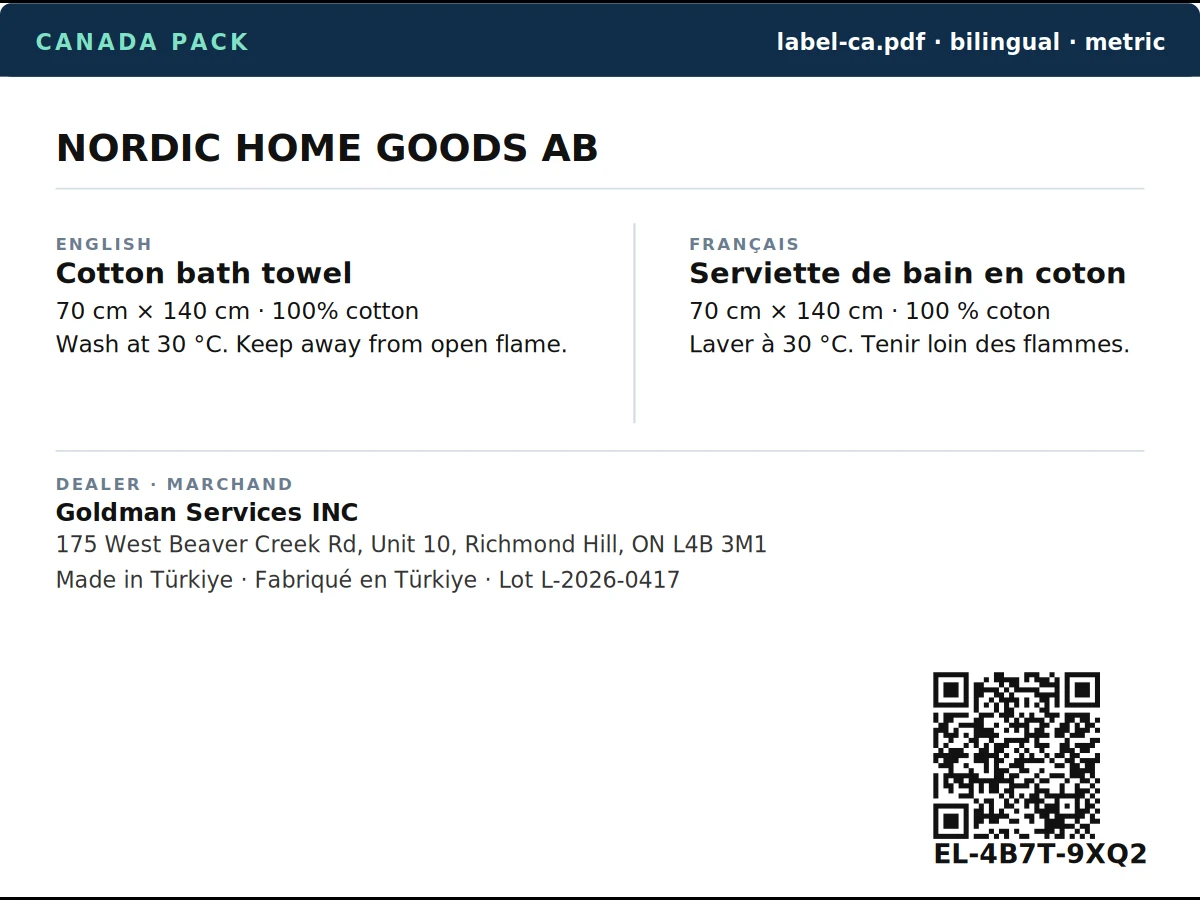
The product identity and the net quantity declaration must appear in both English and French. The dealer's name and principal place of business may appear in either language.
Bilingual does not mean a smaller French line underneath. The two versions carry equal weight, and an inspector reads the French one first if the complaint came from Quebec.
Net quantity is declared in metric units using the prescribed symbols, with a minimum type height tied to the area of the principal display surface. Imperial figures may be added, but the metric declaration is the legal one.
The label must identify the dealer — the person who manufactures, processes, produces or packages the product, or for whom it is made — with the principal place of business. An importer may be named as such with its Canadian address.
Our Canadian packs are signed by Goldman Services INC in Richmond Hill, Ontario, so the address printed belongs to a company established in the country.
The Charter of the French Language adds its own requirements on packaging, inscriptions and, increasingly, on trade marks appearing on the package. Products designed for the rest of Canada often need a Quebec-ready variant, and we produce it from the same record.
The net quantity declaration has a minimum type height tied to the area of the principal display surface, and the figures must be in bold type. Small packages do not get an exemption from the declaration, only a smaller prescribed size.
The declaration sits in the bottom third of the principal display panel in most cases, which constrains a layout designed for another market.
Where a product is sold by count rather than measure, the count is declared in the same way and the same bilingual rule applies.
The Charter of the French Language governs inscriptions on products, on packaging and on documents supplied with them, and recent amendments extend to trade marks appearing on the package where a generic term or description is included.
In practice this means a French version of descriptive elements even where the brand itself is protected, and a layout that leaves room for it from the start rather than as a sticker afterwards.
An imported product must identify either the Canadian dealer, or the foreign manufacturer with an indication that the goods were imported. The wording matters, and 'Imported by' followed by a Canadian address is the cleanest route.
| Element | English | French | Either |
|---|---|---|---|
| Product identity | Required | Required | |
| Net quantity | Required | Required | |
| Dealer name and address | Either language | ||
| Instructions and warnings | Required | Required | |
| Marketing copy | Either, subject to Quebec |
The same information, in the order an inspector or a reviewer meets it.
Usually yes, if it is permanent, legible and does not cover other mandatory information.
Product identity and net quantity do. Marketing copy does not, although Quebec has its own view on how much French must appear overall.
Not for labelling, but the dealer identified must have a Canadian place of business, which is why our Canadian entity signs those packs.
Often yes, if it carries the bilingual identity and quantity and the US identity block, but the type sizes differ and must satisfy both.
Yes for the federal bilingual elements, everywhere in Canada.
Yes if permanent, legible and not covering other required information.
Print-ready artwork for the markets you sell in, a permanent code with a public record, and a free reissue whenever your details change. Seven days free, no card.
 EU Label Compliance