United Kingdom
A label that satisfies Brussels does not automatically satisfy London. Great Britain runs its own conformity system, asks for its own operator and, for several categories, its own mark.
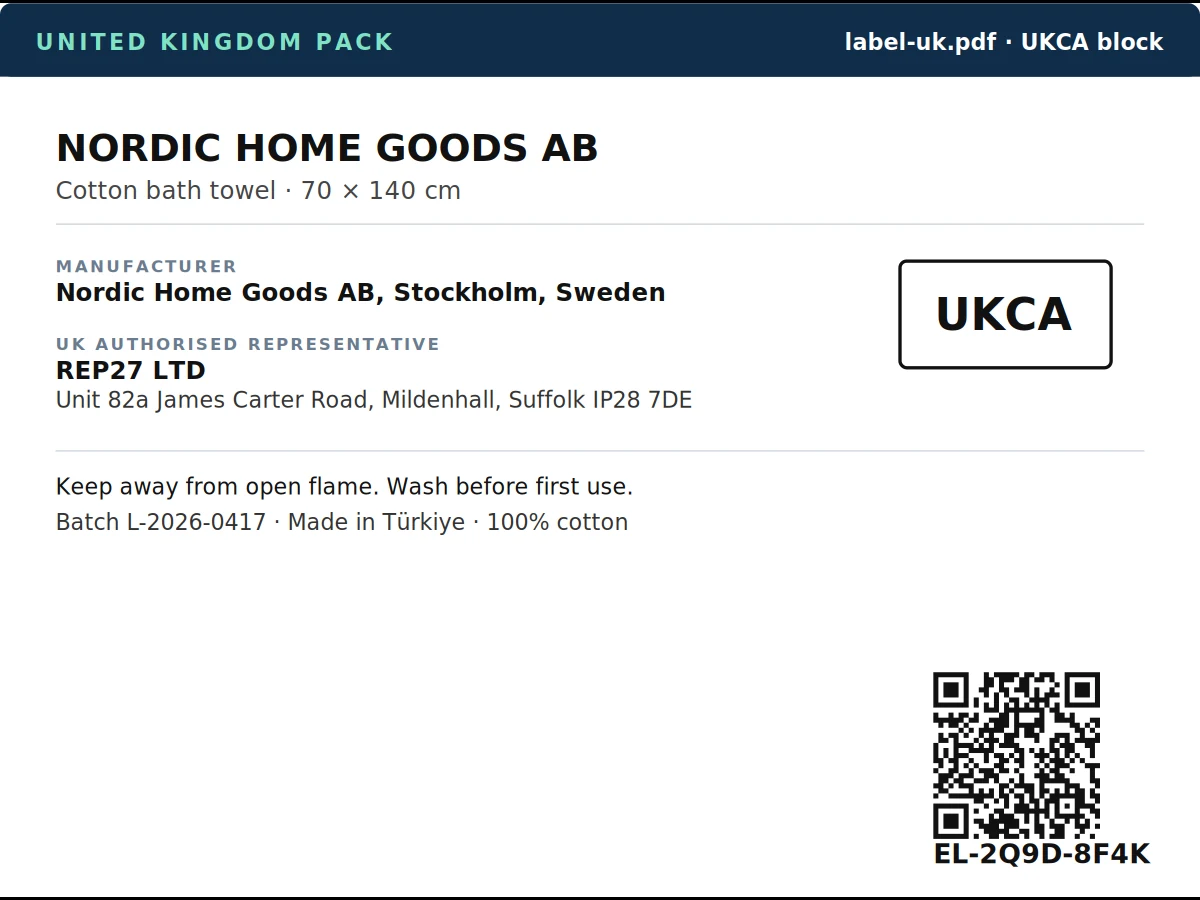
Goods placed on the market in Great Britain need an importer or an authorised representative established in the UK, named with a British postal address. An EU responsible person does not cover Britain, and a British one does not cover Ireland.
Our UK packs are issued by REP27 LTD in Mildenhall, Suffolk, so the address printed on the label belongs to a company that exists in the jurisdiction.
UKCA is the British counterpart of CE for the regulated categories: electrical safety, EMC, toys, machinery, PPE and others. It is applied by the manufacturer on the basis of a UK declaration of conformity.
Recognition of CE marking has been extended for several categories, and the picture has moved more than once. We place the mark your category and your date actually require, and we say plainly when the safest layout is to carry both marks.
English, and English that a British consumer reads as English. Instructions translated for the EU market and reused for Britain are usually understandable, but they read as foreign and are the first thing a reviewer notices.
Age warnings, care symbols and material declarations follow the same category rules as the EU in most cases, which is why the two packs share a product record and differ only where the law differs.
Northern Ireland continues to follow EU product rules. A product sold across the whole of the United Kingdom therefore often carries both the EU and the UK blocks, which is exactly what the two packs together produce.
For many categories, CE marking continues to be recognised in Great Britain indefinitely under legislation passed in 2024, provided the product meets requirements that remain aligned. For others, UKCA is the only route.
The safe practice for a seller with stock going both ways is a label that carries both marks and both operators, rather than two production runs and a warehouse decision.
Where the category has diverged — some construction products, medical devices, certain machinery — the two markets genuinely need separate files, and we say so instead of printing both marks on hope.
A GB importer must put their name and address on the product, or on the packaging or accompanying documents where the product is too small. That block is separate from the manufacturer's.
Where a distributor buys from an EU seller after Brexit, they are usually the importer. Many discover this only when an authority writes to them, because the pre-2021 paperwork never mentioned it.
Northern Ireland applies EU rules, so goods moving there from Great Britain can need the EU set. The UKNI marking exists for the narrow case where a UK body did the assessment for goods sold in Northern Ireland.
In labelling terms the answer is usually simple: carry the EU blocks for Northern Ireland and Ireland, the GB blocks for Britain, on the same artwork.
| Element | European Union | Great Britain |
|---|---|---|
| Conformity mark | CE | UKCA, or CE where recognised |
| Operator on the label | EU responsible person | UK importer or authorised representative |
| Declaration | EU declaration of conformity | UK declaration of conformity |
| Language | Language of each member state | English |
| Northern Ireland | Follows the EU column | UKNI only in narrow cases |
The same information, in the order an inspector or a reviewer meets it.
If you sell in both markets, usually yes, and both marks can sit on the same artwork.
Yes, if they import the goods. That makes them the importer with the obligations attached, so agree it in writing first.
No. The address has to belong to an operator who has actually accepted the role.
For many categories yes, under the recognition legislation. For others UKCA is required, and the list has moved more than once.
It has to be an operator established in the UK with a real address able to receive correspondence.
English is accepted in Ireland for consumer information; Irish is not required on labels.
Print-ready artwork for the markets you sell in, a permanent code with a public record, and a free reissue whenever your details change. Seven days free, no card.
 EU Label Compliance