 EU Label Compliance
Selling consumer products in the EU without an established presence means accepting a specific legal obligation: a named economic operator with a European address must appear on the product, the packaging, or an accompanying document before the goods reach a customer.
Two separate regulations impose this requirement, and both are currently in force.
Which laws actually require it?
Article 16 of Regulation (EU) 2023/988 — the General Product Safety Regulation, which replaced the previous directive from 13 December 2024 — covers virtually all consumer goods placed on the Union market. Article 4 of Regulation (EU) 2019/1020 on market surveillance applies on top of that to every CE-marked product category. A non-EU manufacturer selling into the EU can satisfy both by appointing an EU-established importer or authorised representative and naming that person on the label.
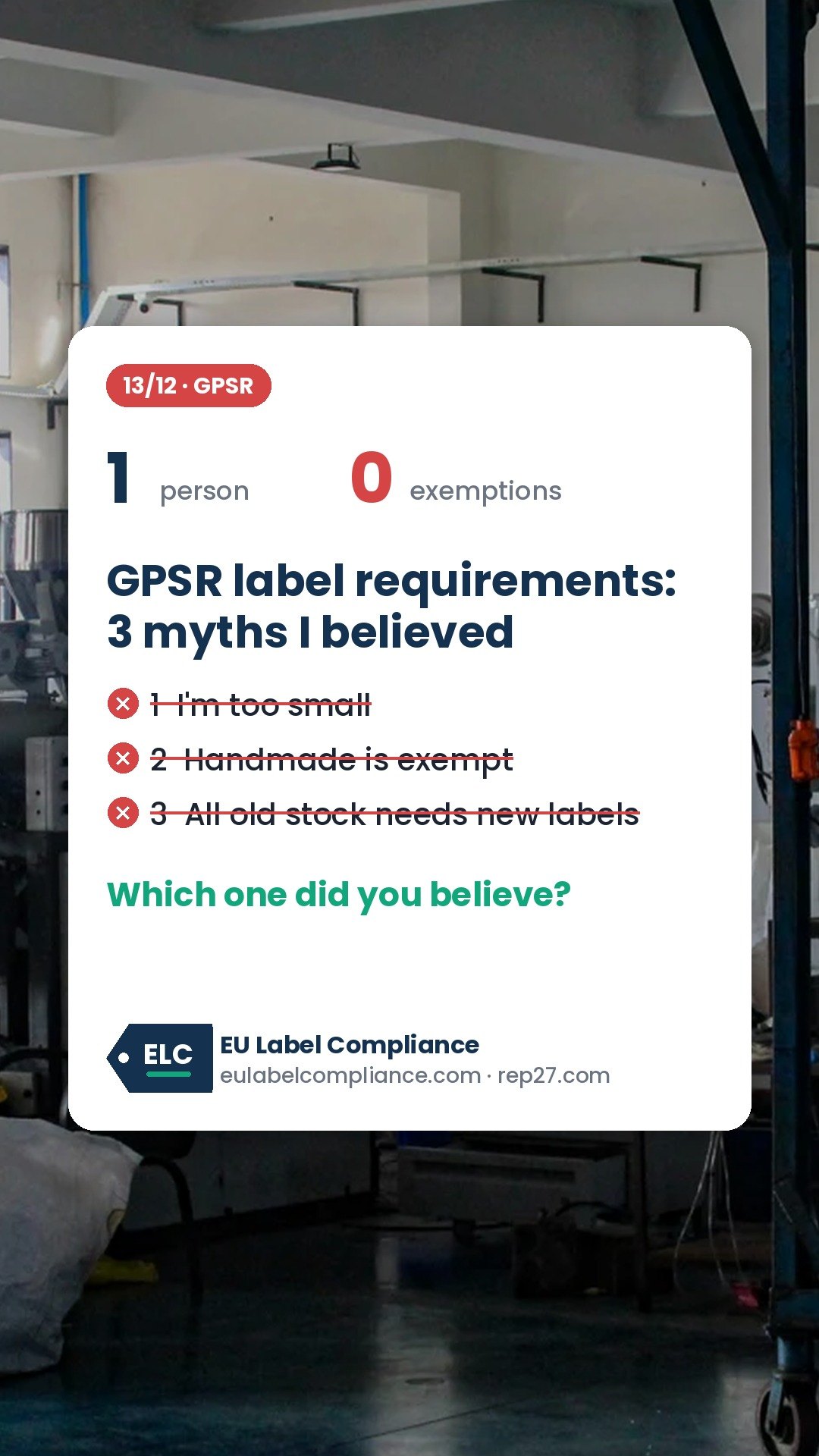
Neither regulation contains an exception for small volumes, individual marketplace listings, or direct-to-consumer shipments from outside the Union.
What information must the label carry?
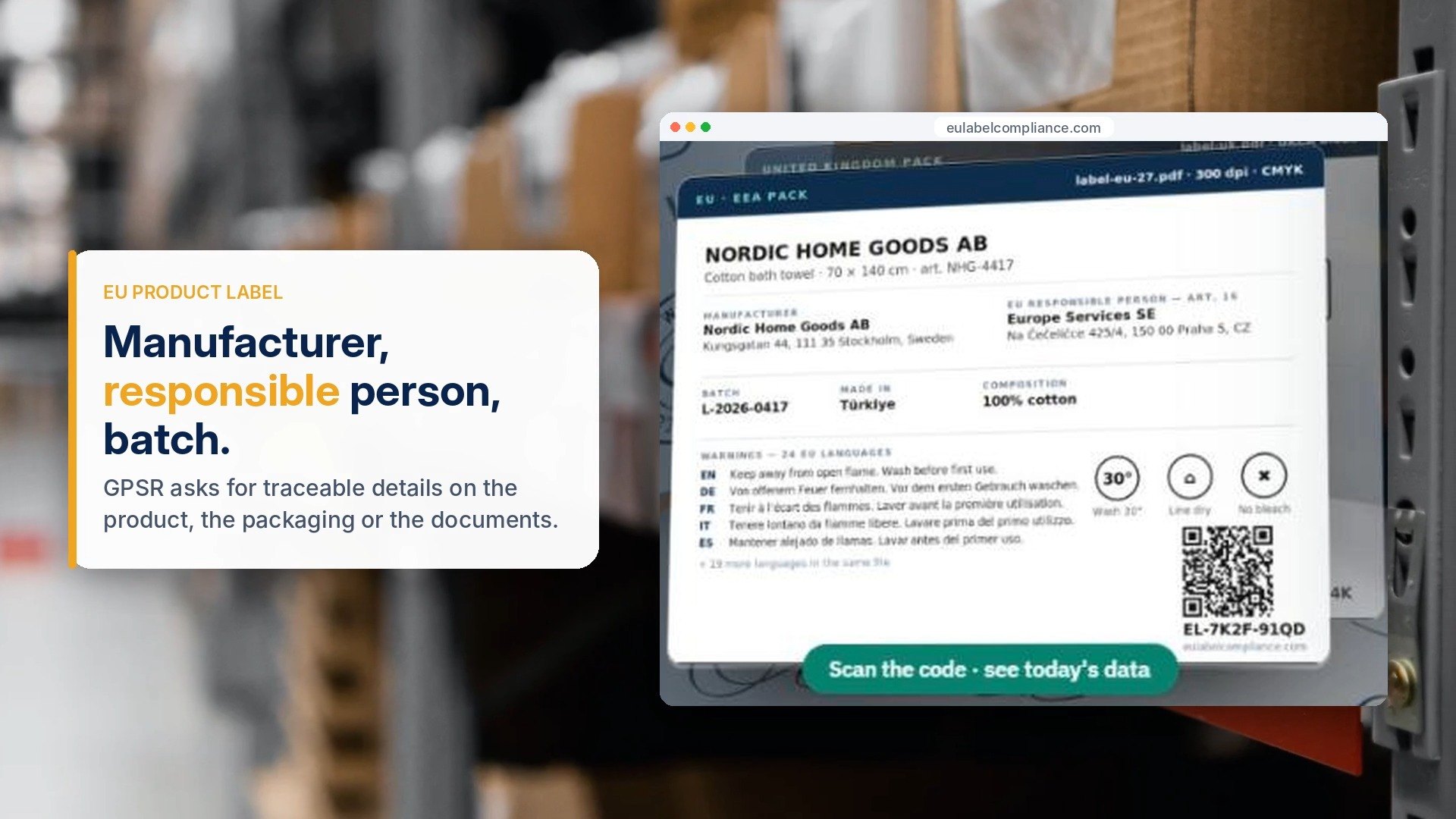
The minimum mandatory block under both regulations includes:
- The responsible person's name and postal address
- A product identifier: type, batch, or serial number
- Safety warnings in the official language of each member state where the product is sold
A data carrier such as a QR code can complement these elements but cannot replace them. The text must be printed and legible on the physical product or its packaging. Where the product is too small to carry the full block, the information moves to the packaging or an accompanying document — but it must appear somewhere in physical, readable form.
What happens when the information is missing?
A market surveillance authority can order corrective action, withdrawal, or recall. Member states set their own penalty ceilings; in several of them the maximum fine is calculated as a percentage of annual turnover rather than a fixed sum. In practice, marketplaces act faster than any authority: listing suspensions on platforms such as Amazon, Temu, and TikTok Shop follow automatically when the required operator details are absent from the listing or the product.
The obligation applies regardless of whether the seller is physically present in the EU, whether sales run through a marketplace, or whether the shipment volume is small.
Who does this affect?
Any business established outside the EU that ships directly to European customers or maintains active listings on EU-facing marketplaces falls under both regulations. The responsible person named on the product must have an actual postal address in a member state — a mailbox or registered-agent address in a non-EU country does not satisfy the requirement.
For CE-marked products, Article 4 of Regulation (EU) 2019/1020 additionally requires the economic operator to hold or have access to the declaration of conformity and the technical documentation, and to cooperate with market surveillance authorities on request.
Getting the label block right before the first shipment is the practical starting point. Once the product is in the supply chain, correcting a missing or incorrect responsible person address means reprinting, relabelling, or withdrawing stock already placed.
Key points
- Article 16 of Regulation (EU) 2023/988 and Article 4 of Regulation (EU) 2019/1020 both independently require a named EU-established economic operator on consumer products sold in the Union.
- The responsible person's name and postal address, a product identifier, and safety warnings in the relevant member state languages must be printed and legible — a QR code alone does not comply.
- Neither regulation exempts non-EU sellers based on sales volume, marketplace channel, or shipment frequency.
- Member states set their own penalties; in several the ceiling is a percentage of turnover, and marketplace suspensions typically arrive before any formal enforcement action.
- For CE-marked products, Article 4 of Regulation (EU) 2019/1020 adds the further requirement that the economic operator hold access to the declaration of conformity and technical documentation.
Frequently asked questions
Which regulations require an EU responsible person on a product label?
Two regulations apply simultaneously. Article 16 of Regulation (EU) 2023/988 (GPSR) covers virtually all consumer goods. Article 4 of Regulation (EU) 2019/1020 covers every CE-marked category. Both require a named economic operator established in the Union, identified on the product, packaging, or accompanying document.
Does an EU responsible person requirement apply to small sellers or low-volume shipments?
No. Neither Regulation (EU) 2023/988 nor Regulation (EU) 2019/1020 contains an exemption based on seller size, sales volume, or the channel used to reach customers. A single-unit listing on an EU marketplace carries the same obligation as a full pallet shipment.
Is a QR code sufficient to show the responsible person's address on an EU product?
No. Under the GPSR, a data carrier such as a QR code can supplement mandatory label information but cannot replace it. The responsible person's name and postal address must be printed and legible on the product, its packaging, or an accompanying document.
What are the consequences of missing an EU responsible person on a product?
A market surveillance authority can order corrective action, withdrawal, or recall. Penalties are set by each member state; in several of them the ceiling is a percentage of annual turnover. Marketplaces suspend listings faster than enforcement authorities typically act.
Does the EU responsible person requirement apply to products sold on Amazon or Temu from outside the EU?
Yes. The obligation follows the product, not the seller's location. A non-EU business with active listings on any EU-facing marketplace — including Amazon, Temu, TikTok Shop, and Etsy — must have an EU-established economic operator named on the product or its packaging before the goods are offered for sale.