 EU Label Compliance
Under Regulation (EU) 2023/988 art. 9, the EU responsible person's name and postal address are mandatory label information. That is not a courtesy field — it is a legal requirement, and it must be accurate at the moment an inspector, a marketplace reviewer or a customs officer checks it.
When you switch EU reps, nothing about your physical stock changes automatically. Every unit sitting in a fulfilment centre, in a container or already on a retailer's shelf carries the former rep's details. From the day the new appointment takes effect, those units are non-compliant.
What actually triggers the problem
Sellers most often discover the mismatch at a marketplace listing review, a customs hold at the border, or a market surveillance check. At that point the options are narrow: pull the stock, reprint and rework, or accept the corrective action. None of those is cheap, and a reprint mid-season across multiple SKUs can reach costs that far exceed a year's labelling budget.
The root cause is a structural one. A printed label is static. The legal situation behind it is not. EU rep contracts expire, businesses restructure, fulfillment shifts between legal entities — all of it happens after the print run.
How a permanent code solves this without a reprint
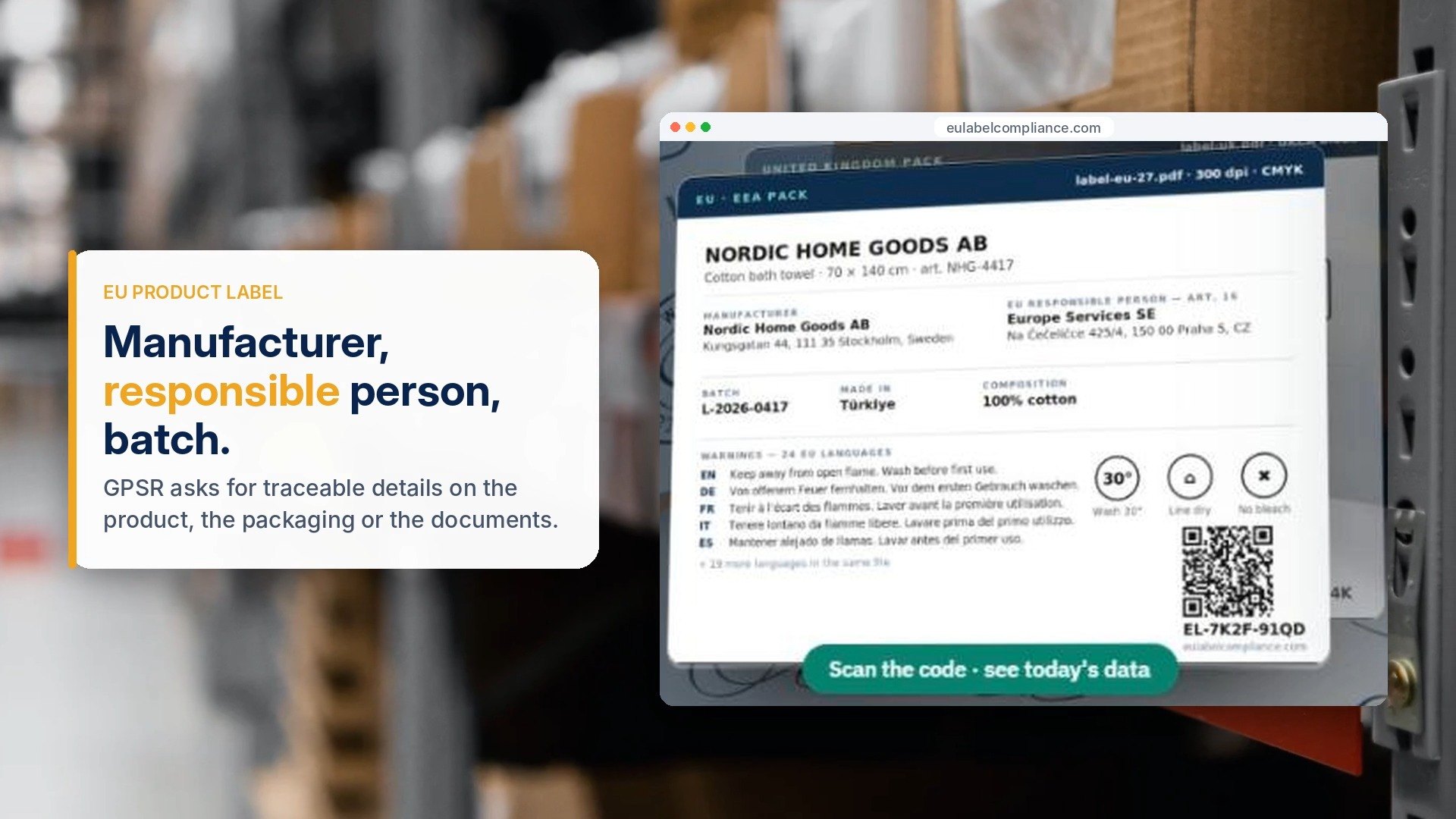
A label that carries a permanent code — a short alphanumeric identifier printed beside a QR — points to a live public record rather than carrying static text alone. The mandatory information appears on the label as required, and the code resolves to a page holding the current data for that product.
When the EU responsible person changes, the record updates. Every label already printed, on every unit already shipped, now resolves to the correct name and address. No new artwork. No new print run. The code printed six months ago serves the same function as a label printed today.
EU Label Compliance issues a permanent code — formatted as EL-XXXX-XXXX — for each product. Changing the responsible person in the account updates the public record immediately. The code on existing labels keeps resolving to the right information.
What the label must still carry in print
A code does not replace printed text. Under the GPSR, a data carrier complements the mandatory information; it does not substitute it. The manufacturer's name and address, the responsible person's name and address, the product identifier, and the applicable safety information must remain legible and indelible on the product or its packaging.
The code adds resilience: it means a subsequent change to the responsible person does not render existing stock non-compliant. The printed block at the time of the original print run was correct; the code ensures that anyone checking now — an inspector, a marketplace reviewer, a buyer — reaches the current version.
Which regulation requires the responsible person
Two regulations impose the obligation. Article 16 of Regulation (EU) 2023/988 on general product safety requires an economic operator established in the Union, named on the product, its packaging or an accompanying document. Article 4 of Regulation (EU) 2019/1020 on market surveillance applies the same requirement to CE-marked categories. Both are currently in force.
Marketplaces — Amazon, Temu, Shein, TikTok Shop and others — now ask for the responsible person's details at the listing level as well as on the product. A mismatch between what is on the label and what is in the account triggers a listing suspension faster than any authority would act.
Subscriptions start at €290 per year for the EU and EEA, covering all 27 member states plus Norway, Iceland and Liechtenstein, with unlimited products. A seven-day free trial requires no card, only a six-digit code sent to a company email address.
Key points
- Regulation (EU) 2023/988 art. 9 requires the EU responsible person's name and postal address to appear on the product or its packaging, and that information must be accurate at the point of any inspection.
- Changing the EU responsible person mid-season makes every unit already printed non-compliant; reprinting warehouse stock across multiple SKUs is the only alternative without a live-record system.
- A permanent code printed on the label — alongside the mandatory text — resolves to a public record that updates when the responsible person changes, so existing stock stays compliant without a new print run.
- Under the GPSR, a QR or data carrier supplements mandatory printed text; it does not replace it — the responsible person's name and address must still appear legibly on the label or packaging.
- Article 4 of Regulation (EU) 2019/1020 imposes the same responsible-person requirement for CE-marked categories, meaning the obligation applies across both general consumer goods and regulated product families.
Frequently asked questions
Does changing my EU responsible person make my printed labels non-compliant?
Yes. Under Regulation (EU) 2023/988 art. 9, the responsible person's name and address must be accurate on the product or its packaging. Units printed with the former rep's details carry incorrect mandatory information from the day the new appointment takes effect.
Can a QR code replace the printed EU responsible person details?
No. The GPSR allows a data carrier to complement mandatory information, not to replace it. The responsible person's name and postal address must remain legible and indelible on the product or its packaging regardless of any QR code present.
Which regulations require an EU responsible person on the label?
Two: Article 16 of Regulation (EU) 2023/988 on general product safety, and Article 4 of Regulation (EU) 2019/1020 on market surveillance for CE-marked categories. Both require an economic operator established in the Union, named on the product, its packaging or an accompanying document.
How does a permanent label code keep stock compliant after an EU rep change?
The code resolves to a live public record for that product. When the responsible person changes, the record updates and every label carrying that code — already printed and in circulation — now resolves to the correct current data, without a reprint.
What does an EU labelling subscription cost for unlimited products?
€290 per year for the EU and EEA, covering all 27 member states plus Norway, Iceland and Liechtenstein, with unlimited products. Three markets cost €590; every market costs €990. A seven-day free trial requires no card.