By category
Cosmetics have their own regulation, their own responsible person and their own ingredient language. Almost nothing from the general regime transfers unchanged.
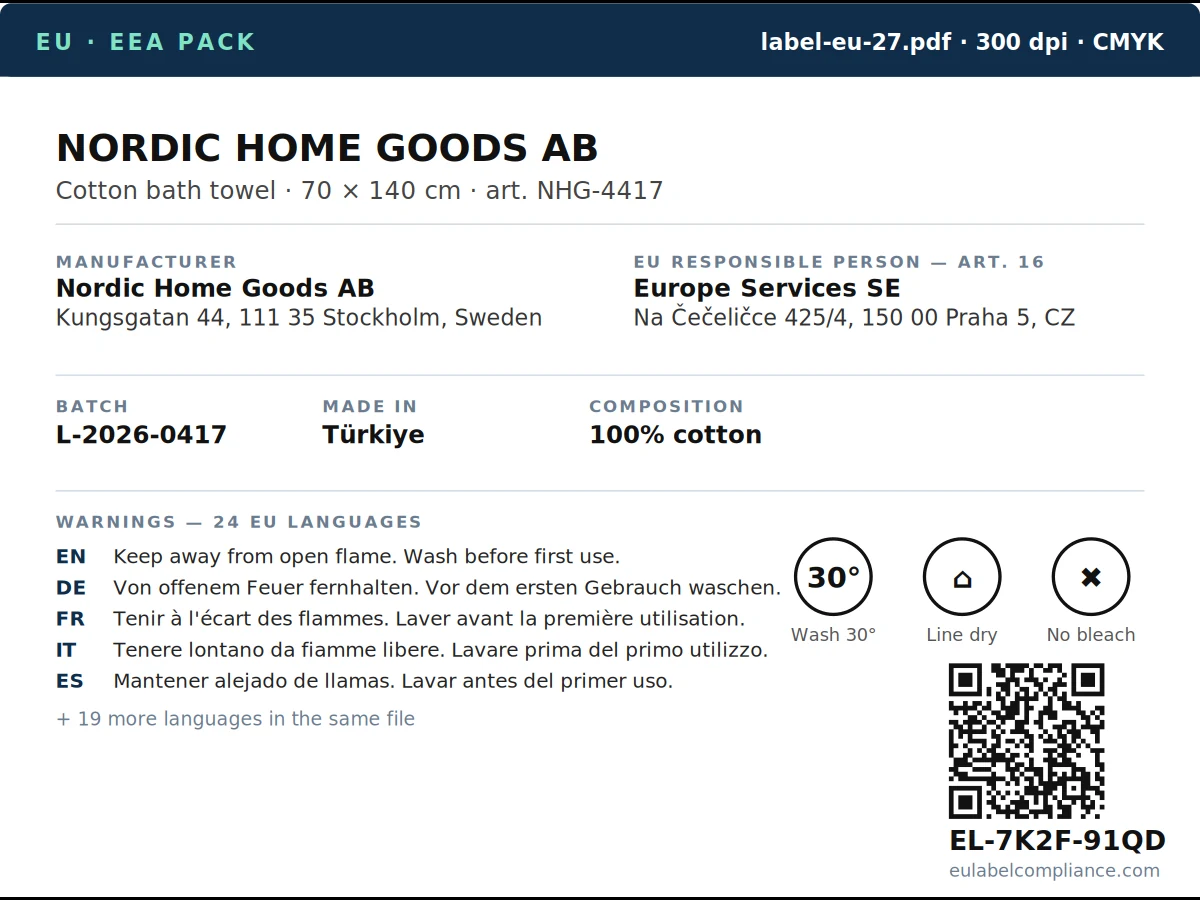
Name and address of the responsible person established in the Union. Nominal content. Date of minimum durability or the period-after-opening symbol. Particular precautions for use. Batch number. Function of the product. The ingredient list in INCI nomenclature, headed 'Ingredients'.
All of it on the container and the outer packaging, with narrow exceptions where size makes it impossible and a leaflet with the book-and-hand symbol takes over.
Ingredients appear under their INCI names in descending order of weight, with perfumes and aromatic compositions declared as such and allergens named where the thresholds apply. 'Aqua', not 'purified spring water'.
As the regulation stands, a data carrier cannot replace any of the eight mandatory fields. It may add information — the full allergen detail, a usage video — but the batch number, the responsible person's address, the PAO symbol and the ingredient list stay printed.
A container layout and an outer packaging layout carrying every mandatory field with the correct symbols, plus the leaflet version where the container is too small, in the languages of the markets you sell in.
Cosmetic claims follow common criteria: legal compliance, truthfulness, evidential support, honesty, fairness and informed decision-making. 'Dermatologically tested' without a test is a claim problem before it is a label problem.
Free-from claims are heavily restricted, and claims denigrating legally permitted ingredients are not allowed. This bites hardest on natural and organic positioning.
Products with a minimum durability of more than thirty months carry the open-jar symbol with the number of months. Products below that carry a best-before date with the hourglass symbol or the words.
The two are alternatives, not decorations, and the choice follows the stability data in the product information file.
Ingredients present as nanomaterials are followed by '[nano]' in the ingredient list. Fragrance allergens above the thresholds are named individually rather than hidden inside 'parfum'.
Both are the kind of detail an authority checks quickly because it needs no laboratory: it is either printed or it is not.
| Field | Container | Outer packaging |
|---|---|---|
| Responsible person name and address | Required | Required |
| Nominal content | Required | Required |
| Durability or PAO symbol | Required | Required |
| Precautions for use | Required | Required |
| Batch number | Required | Where space allows |
| Function of the product | Required | Required |
| Ingredient list (INCI) | Where space allows | Required |
The same information, in the order an inspector or a reviewer meets it.
Not under this service. We produce the artwork; the cosmetics responsible person is a separate legal role with a product information file behind it.
No. Notification is a separate obligation and it belongs to the responsible person.
Only where the container genuinely cannot carry it, and then the rules on leaflets and symbols apply.
Only where the container and packaging genuinely cannot carry it, with the book-and-hand symbol.
Yes, and where space is impossible it moves to the outer packaging.
No. It belongs to the responsible person and is outside this service.
Print-ready artwork for the markets you sell in, a permanent code with a public record, and a free reissue whenever your details change. Seven days free, no card.
 EU Label Compliance