 EU Label Compliance
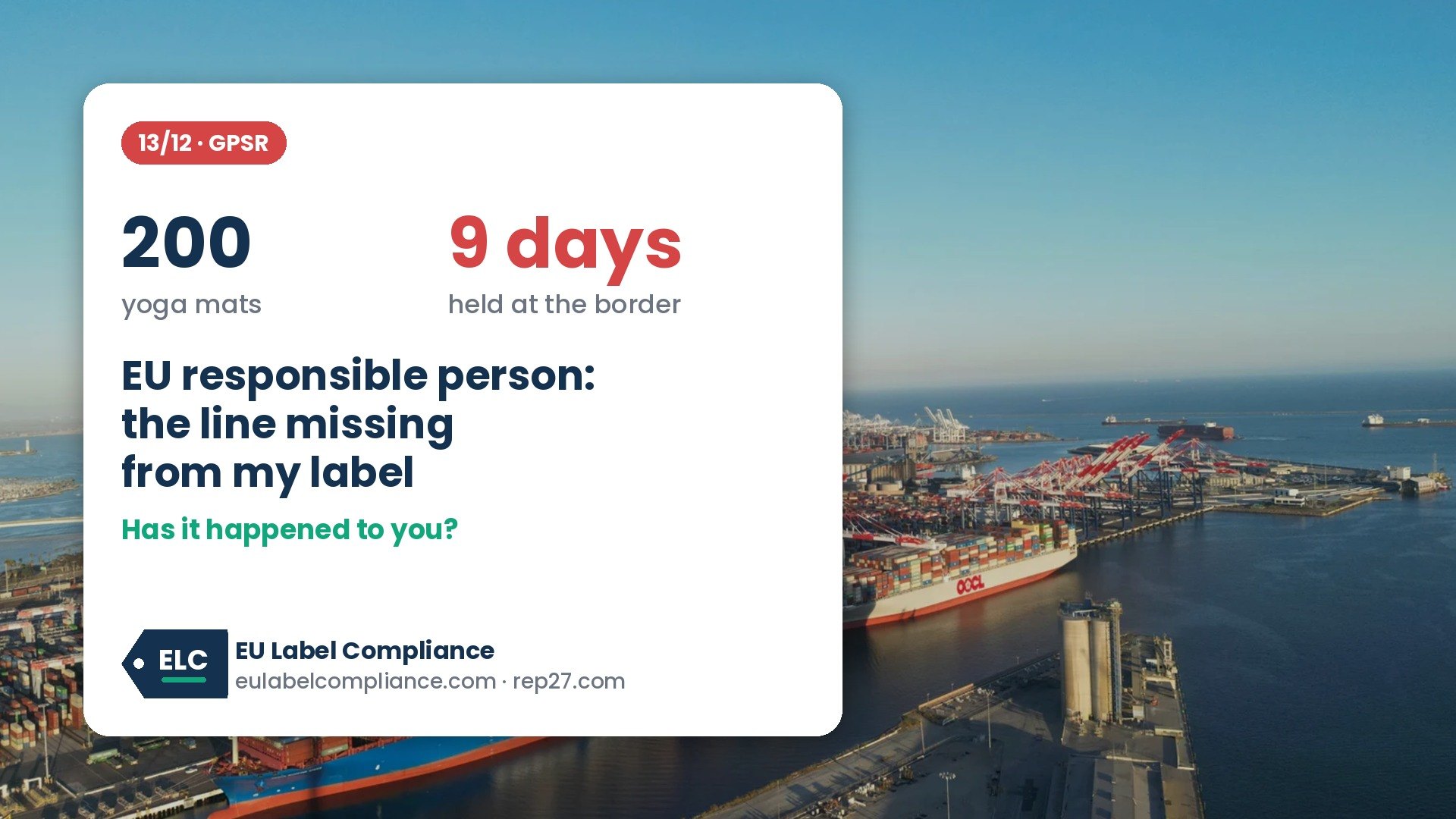
A label fix ordered after a product has shipped costs more than the label itself. Rush print runs, same-day translation fees charged at double rate, and warehouse storage while a pallet waits for a sticker are line items that compound quickly. One seller who tracked every post-shipment label correction over twelve months arrived at $2,680 spent — on a problem that could have been resolved with correct artwork before the first order went out.
The pattern repeats across sellers in three recognisable forms: correcting labels one sticker at a time after a marketplace flags the listing, paying for a new rush translation every time a new country is added, or holding stock in a warehouse while a single missing line is resolved. Any one of these is expensive. Running two or three in parallel for a year is a significant operational cost for a small brand.
What must actually appear on an EU product label?
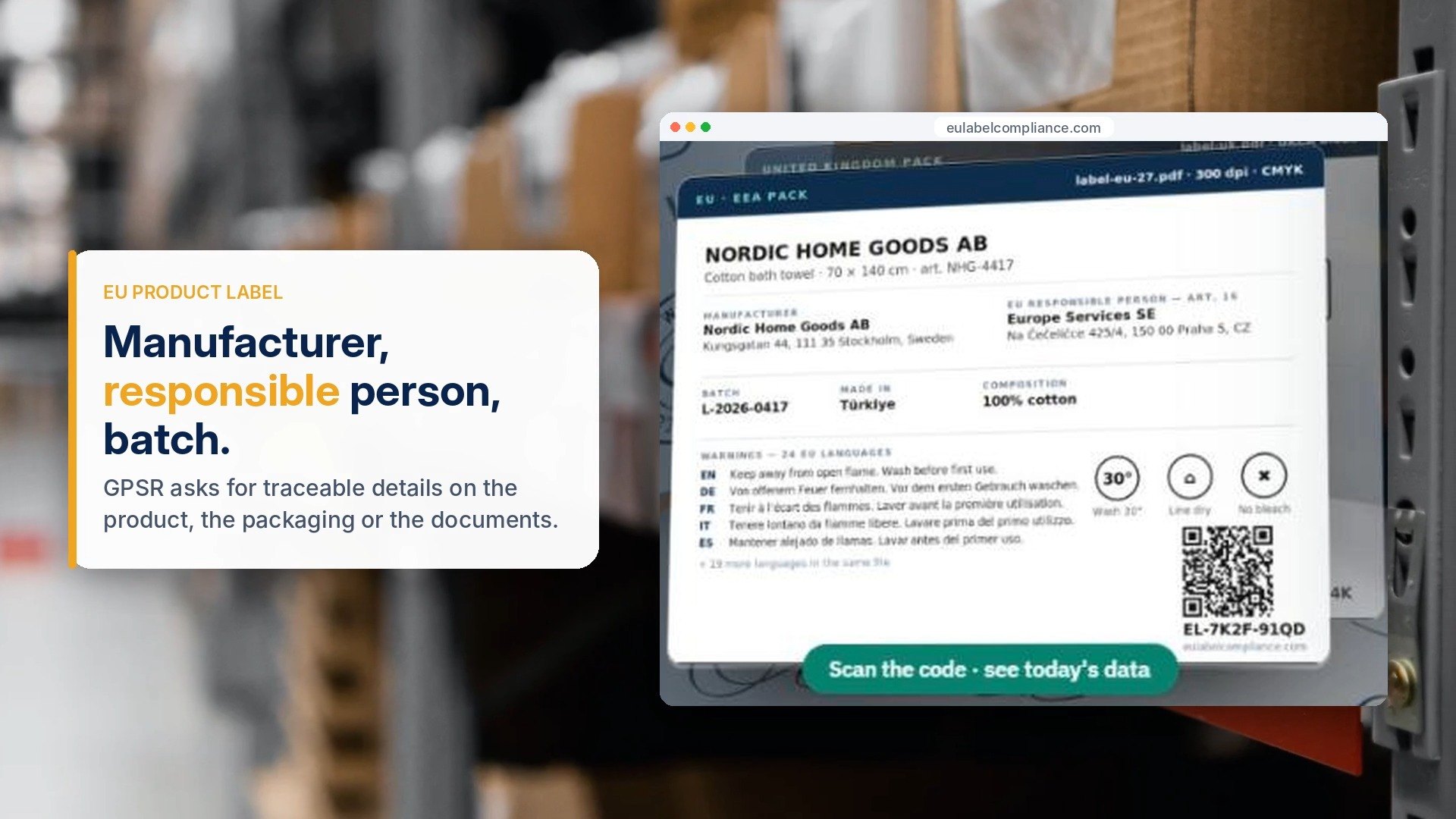
Two regulations set the mandatory blocks. Article 9 and article 16 of Regulation (EU) 2023/988 on general product safety require the manufacturer's name and postal address, the name and address of an EU responsible person (an economic operator established in the Union), a type, batch or serial number, and safety warnings in the language of every member state where the product is sold. Article 4 of Regulation (EU) 2019/1020 on market surveillance applies the same operator requirement to CE-marked categories. Missing any one of these blocks is enough for a marketplace to suspend a listing or for a market surveillance authority to order corrective action.
For sellers distributing across the EU, the language requirement alone creates volume: 24 official EU languages, all of which must appear on or with the product if it is sold in those markets. A label ordered before the first shipment covers all of them in one step. A label corrected country by country, as each new market is opened, multiplies the translation cost and delays each launch.
What does compliant EU label artwork cost?
EU Label Compliance (eulabelcompliance.com) produces print-ready label artwork — 300 dpi CMYK PDF with 3 mm bleed, SVG with live text, and a 1:1 PNG proof — plus a permanent public record per product. The subscription is EUR 290 per year for the EU market, with unlimited products on that plan. A seller with 400 SKUs in the EU pays EUR 290 per year, not EUR 290 per product. The EU pack covers all 27 member states plus Norway, Iceland and Liechtenstein, in all 24 official EU languages.
For sellers also active in the UK, US, Canada, or Australia, three markets cost EUR 590 per year and all markets cost EUR 990 per year. Each market is a separate rule set: the UK requires a UK-established importer or authorised representative and UKCA marking where applicable; Canada requires bilingual English/French labelling with metric quantities first; the US requires country-of-origin marking under 19 U.S.C. 1304.
Why marketplace suspensions happen faster than authority action
Market surveillance authorities in EU member states can order withdrawal, recall, or corrective action, with penalties that in several member states reach a percentage of annual turnover. In practice, marketplaces — Amazon, Temu, Shein, TikTok Shop, Etsy — suspend listings the moment a required block is missing or an EU responsible person cannot be verified, often before any authority has been involved. A listing offline for a week is a direct revenue loss. Storage fees during that week add to it. The fix — a rush reprint, a rush translation — adds to it again.
A label produced before the product ships eliminates all three costs. The mandatory blocks are present from the first listing, the responsible person is named and verifiable, and the identifier on each unit points to a public record that stays current even if business details change after printing.
Key points
- Regulation (EU) 2023/988 art. 16 and Regulation (EU) 2019/1020 art. 4 both require an EU responsible person named on the product or its packaging.
- Post-shipment label corrections generate stacked costs: rush reprints, rush translations, and storage fees while listings are suspended.
- EU label artwork from eulabelcompliance.com costs EUR 290 per year for unlimited products across all 27 EU member states plus EEA, in all 24 EU languages.
- Marketplaces suspend listings faster than market surveillance authorities issue corrective orders, making a missing label block an immediate revenue problem.
- A permanent product code printed on the label points to a public record that updates without requiring a reprint when business details change.
Frequently asked questions
What mandatory information must appear on an EU product label?
Under Regulation (EU) 2023/988 art. 9 and 16, the label must carry the manufacturer's name and postal address, the name and address of an EU responsible person established in the Union, a product identifier (type, batch or serial number), and safety warnings in the language of every country where the product is sold. Regulated categories add CE marking and category-specific symbols on top of these base requirements.
Why do marketplace listings get suspended over label problems?
Amazon and other marketplaces check that the mandatory label blocks are present and that an EU responsible person with a Union address is named in the listing. If any required element is missing or unverifiable, the listing is suspended — typically faster than any market surveillance authority would act. A week offline is a direct revenue loss on top of the cost of the fix.
How much does it cost to get EU-compliant label artwork before shipping?
EU Label Compliance charges EUR 290 per year for the EU market, covering unlimited products across all 27 member states plus Norway, Iceland and Liechtenstein, in all 24 official EU languages. Three markets cost EUR 590 per year; all markets (EU, UK, US, Canada, Australia/New Zealand) cost EUR 990 per year.
Does one EU label cover all EU member states?
Yes. A single label order under the EU plan covers all 27 member states plus the three EEA countries (Norway, Iceland, Liechtenstein), with mandatory text in all 24 official EU languages included at no additional charge per language.
Can a QR code replace printed mandatory text on an EU product label?
No. Under the GPSR (Regulation (EU) 2023/988), a data carrier such as a QR code can complement the mandatory information but cannot replace it. The manufacturer block, the EU responsible person, the product identifier, and safety warnings must remain printed and legible on the product or its packaging.