United States
Proposition 65 is not a product ban and not a safety standard. It is a warning law, and it is enforced largely by private plaintiffs, which is why it produces more letters than inspections.
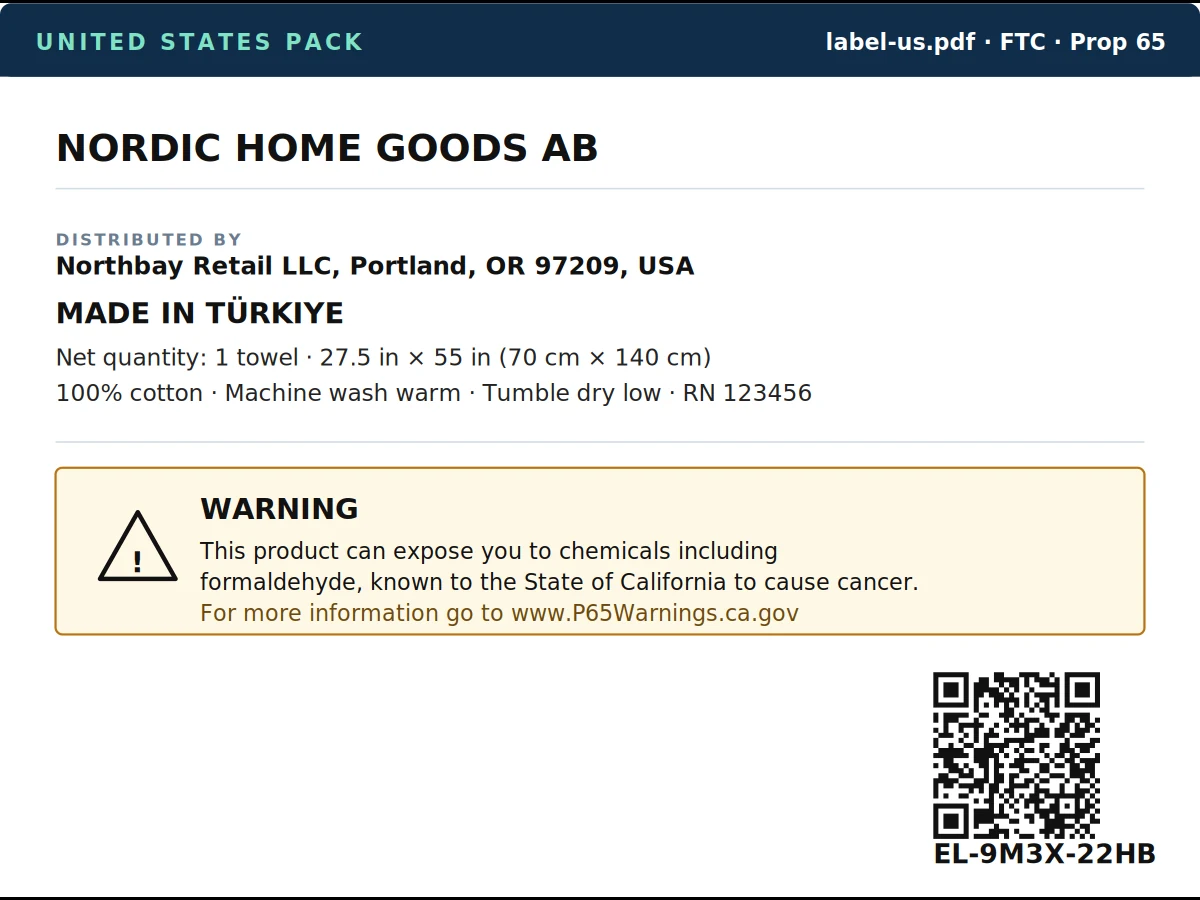
When a product can expose a person in California to a listed chemical above the safe harbour level. The list runs to about a thousand substances and moves; lead, phthalates, formaldehyde, BPA and certain flame retardants account for most consumer cases.
Exposure, not presence, is the test. A substance sealed inside a component that nobody touches may not require a warning at all — but that judgement belongs to a laboratory and a lawyer, not to a label.
The safe harbour warning uses the word WARNING in capitals, a yellow equilateral triangle with an exclamation mark, the name of at least one listed chemical, the risk category — cancer, birth defects or other reproductive harm — and the address www.P65Warnings.ca.gov.
The short form is allowed on smaller packages under the current rules, with its own restrictions on when it can be used. The long form names the chemical and the effect and is the safer default on packaging with space.
A warning printed so small or so far from the display panel that it is not 'clear and reasonable'. A warning listing chemicals that are not actually present, which courts treat as over-warning. A warning translated into another language without also carrying the English required text.
You tell us which listed chemical applies, from your supplier declaration or a test report. We place the correct short or long form with the compliant symbol, typography and URL, in the position that keeps it clear and reasonable on your layout.
Most Proposition 65 cases begin with a private plaintiff sending a sixty-day notice, not with a state inspection. The notice names the product, the chemical and the exposure route, and copies the Attorney General.
Settlements commonly combine a civil penalty with a commitment to warn or reformulate. Sellers who already had a compliant warning in place generally end the matter quickly; those who had none pay for the education.
The practical defence is documentation: supplier declarations, test reports, and a dated record of which warning was applied to which production run.
The short form warning was widely used because it fitted anywhere. Amendments have narrowed when it may be used and now require the chemical to be named in most cases, which removes the reason many sellers chose it.
Where the package genuinely cannot carry the long form, the short form with the named chemical is the route, and the online listing must carry the same warning before purchase.
For internet purchases the warning must appear before the consumer completes the transaction — on the product page, not only in the box. Marketplaces provide a dedicated field, and leaving it empty while the label carries the warning is still a failure.
| Long form | Short form | |
|---|---|---|
| Symbol | Yellow triangle with exclamation mark | Same, smaller |
| Signal word | WARNING | WARNING |
| Chemical | Named, with effect | Named, under the current rules |
| URL | www.P65Warnings.ca.gov | Same |
| Best used | Packaging with space | Small packages only |
The same information, in the order an inspector or a reviewer meets it.
You can, and many sellers do, but blanket warnings have been criticised by courts and by the state. Warn where an exposure is credible.
On the label, the packaging or, for online sales, in the listing before purchase. Marketplaces have their own field for it.
No, but most sellers cannot segregate stock, so the warning ends up on everything shipped to the United States.
Businesses with fewer than ten employees are exempt, but the marketplace and the retailer above you usually are not.
Most sellers apply the warning to all US stock rather than segregating it.
No, and the statute says so, but over-warning has been criticised by courts and by the state.
Print-ready artwork for the markets you sell in, a permanent code with a public record, and a free reissue whenever your details change. Seven days free, no card.
 EU Label Compliance