By category
Textiles carry two layers: the safety blocks every consumer product needs, and the fibre rules that belong to textiles alone.
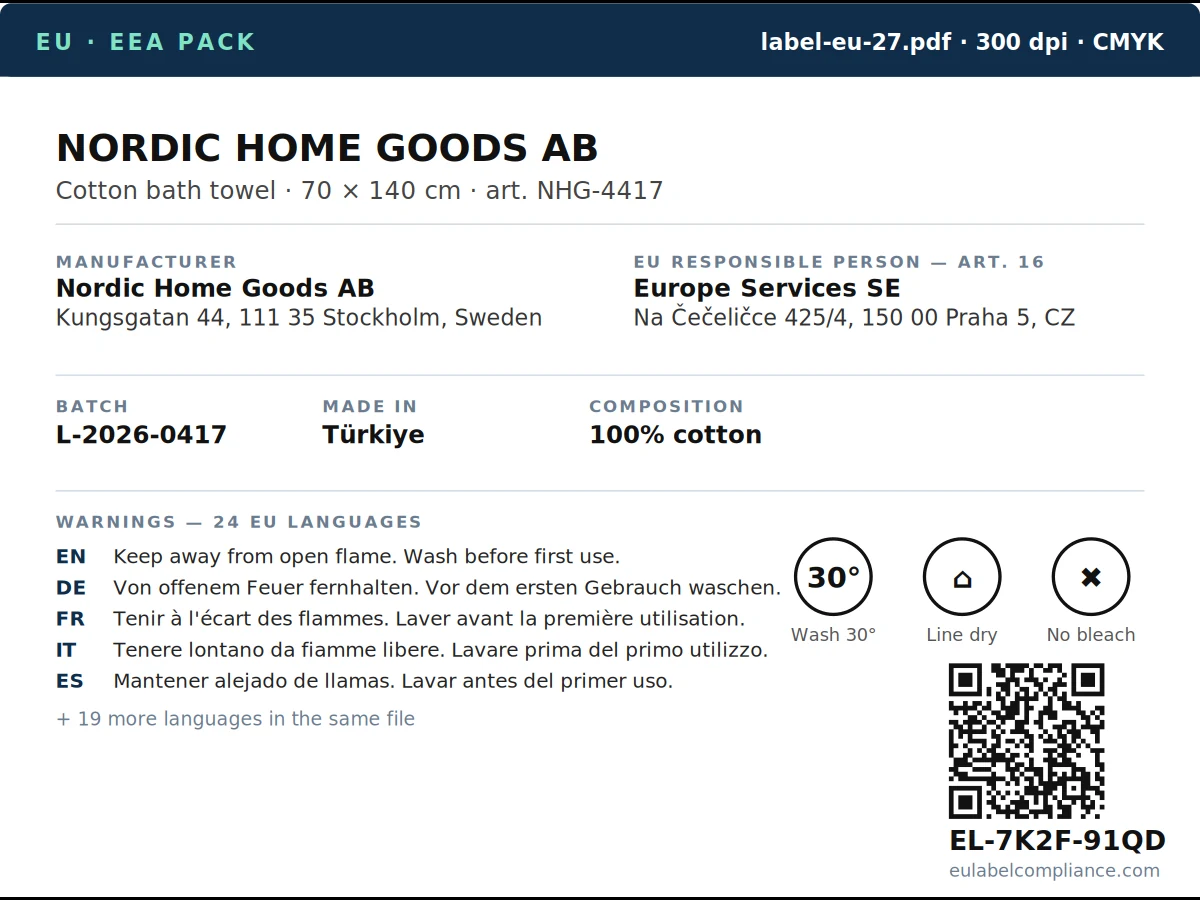
Regulation (EU) 1007/2011 requires the full fibre composition by weight, in descending order, using the fibre names in the regulation's own list. 'Cotton rich' or 'mixed fibres' are not fibre names.
The composition label must be durable, legible and accessible, which in practice means sewn in rather than printed on a hangtag that the shop removes.
Care labelling is not mandatory under EU law, but it is commercially unavoidable and it is regulated when it appears: the symbols come from a standard, and inventing a pictogram is a claim like any other.
We draw them as vectors at the right proportions rather than pasting low-resolution images, which is the single most common reason a textile tag looks counterfeit.
The GPSR blocks still apply: manufacturer, responsible person, batch. Country of origin is not mandatory for textiles in the EU, but if you state it, it must be true under customs origin rules.
Children's clothing adds cord and drawstring requirements from EN 14682, which change where a label may physically sit.
A sewn-in composition and care tag, plus the packaging or hangtag layout carrying the identity blocks and the warnings in all 24 languages, from one product record.
Only names in Annex I of Regulation (EU) 1007/2011 may be used. Invented marketing names for a fibre, or a brand name used as if it were a fibre, are not permitted without the underlying generic name.
Tolerances exist for extraneous fibres and for visible, isolatable decorative fibres, but they are narrow and have to be stated where they apply.
Products containing non-textile parts of animal origin carry the phrase 'Contains non-textile parts of animal origin' in the language of the market.
A product made of several components with different fibre compositions carries the composition of each component. Sets sold together follow the same logic rather than an average.
Linings, interlinings and stiffening carry their own declaration where they are a significant part of the product.
The composition label has to stay with the garment. A printed hangtag is removed at the till, which is why sewn-in labels remain the practical answer, and why the print method has to survive washing at the temperature the care symbol promises.
| Information | Sewn-in label | Hangtag or packaging |
|---|---|---|
| Fibre composition | Required | Optional duplicate |
| Care symbols | Usual place | Optional |
| Manufacturer and responsible person | Optional | Required |
| Batch number | Optional | Required |
| Warnings and language versions | Space permitting | Required |
The same information, in the order an inspector or a reviewer meets it.
No. It has to stay with the garment, which means a sewn-in label in almost every case.
Fibre names must appear in the language of the market; symbols and figures do the rest, which is why the tag stays small.
For textiles sold in the EU you may state origin, but it must be a real customs origin, and 'Made in EU' is accepted only in limited contexts.
Not in the EU, but when you use them they must follow the standard, and buyers expect them.
Not as a composition. State the percentages by weight with Annex I names.
Usually on the hangtag or the packaging, with the sewn-in label carrying composition and care.
Print-ready artwork for the markets you sell in, a permanent code with a public record, and a free reissue whenever your details change. Seven days free, no card.
 EU Label Compliance