By category
Electrical goods carry the densest label of all: conformity, safety data, environmental marks and identity, on the smallest surfaces.
The CE mark, applied by the manufacturer on the basis of the applicable directives — Low Voltage, EMC, RoHS, Radio Equipment where relevant. Alongside it the rating data: voltage, frequency, power, and the protection class or IP rating where the standard requires it.
Identity blocks follow the same rules as any other product: manufacturer, importer or responsible person, and a model or batch identifier.
The WEEE mark tells the consumer not to dispose of the item with household waste. It must appear on the product, and where size prevents it, on the packaging and the instructions. A black bar under the bin indicates the product was placed on the market after August 2005.
The mark is about the label. Registration in national WEEE registers and the fees attached are a separate obligation and one we do not handle.
If a battery is included, the battery rules add their own markings and separate collection symbol. Packaging carries its own identification in several member states.
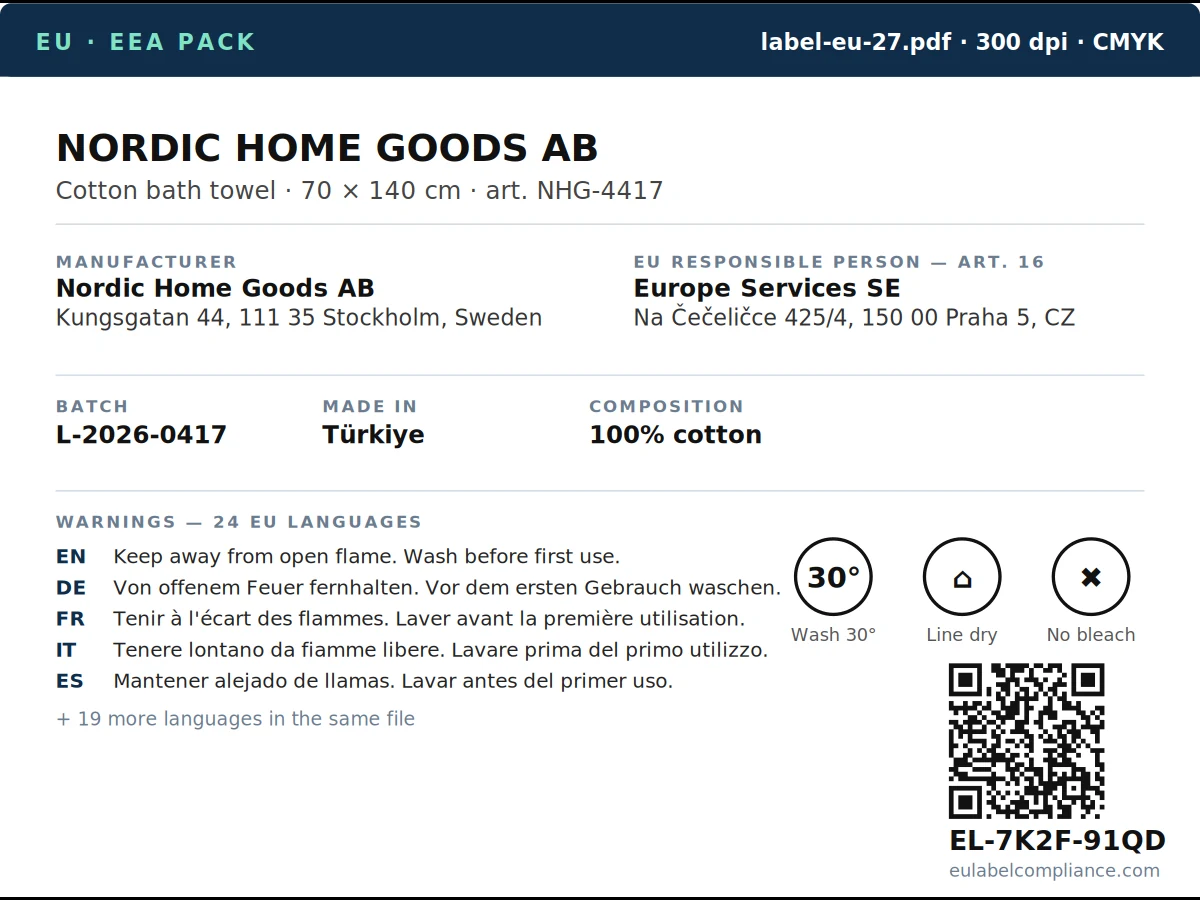
A rating plate layout and a packaging layout, with the CE block, the environmental marks drawn to the prescribed proportions, the rating data, the identity blocks and warnings in the languages of your markets.
The rating plate carries the data an installer and a technician need: rated voltage and frequency, rated power or current, protection class or IP rating, and the model reference. For some categories, connection diagrams or fuse ratings follow.
The plate must survive the life of the product. Printed paper glued to a hot surface is not a rating plate.
Where a product carries a built-in power supply, the supply's own data appears too, and mismatches between the two are a frequent finding.
Products with radio functionality fall under the Radio Equipment Directive, which brings frequency bands and maximum transmitted power into the instructions, plus restrictions in certain member states where they apply.
Chargers and cables increasingly attract their own rules, including the common charger requirements and the related pictograms on packaging.
A product with an integrated battery carries the separate collection symbol and, above threshold levels, the chemical symbol for lead, mercury or cadmium. Battery regulation obligations sit with whoever places the battery on the market, and that is often you.
| Mark | Meaning | Where |
|---|---|---|
| CE | Conformity with the applicable directives | Product or rating plate |
| Crossed-out wheeled bin | Separate collection, not household waste | Product, else packaging |
| Class II symbol | Double insulated, no earth | Rating plate |
| IP rating | Ingress protection | Rating plate where required |
| Battery symbols | Separate collection and chemical symbol | Battery or product |
The same information, in the order an inspector or a reviewer meets it.
No. We produce the label. National registration and eco-contributions are a separate service we deliberately do not sell.
Yes, if it is permanent and legible for the life of the product.
When the product is too small to carry it legibly, yes — on the packaging and in the instructions.
The bar indicates placing on the market after 13 August 2005 and is part of the standard mark.
No. It is demonstrated in the documentation; printing a RoHS logo is a claim, not a requirement.
The producer in each member state. It is a national registration and outside this service.
Print-ready artwork for the markets you sell in, a permanent code with a public record, and a free reissue whenever your details change. Seven days free, no card.
 EU Label Compliance