How we work
A QR code is a convenience for the consumer and, done properly, an insurance policy for the seller. It is never a substitute for printed text.
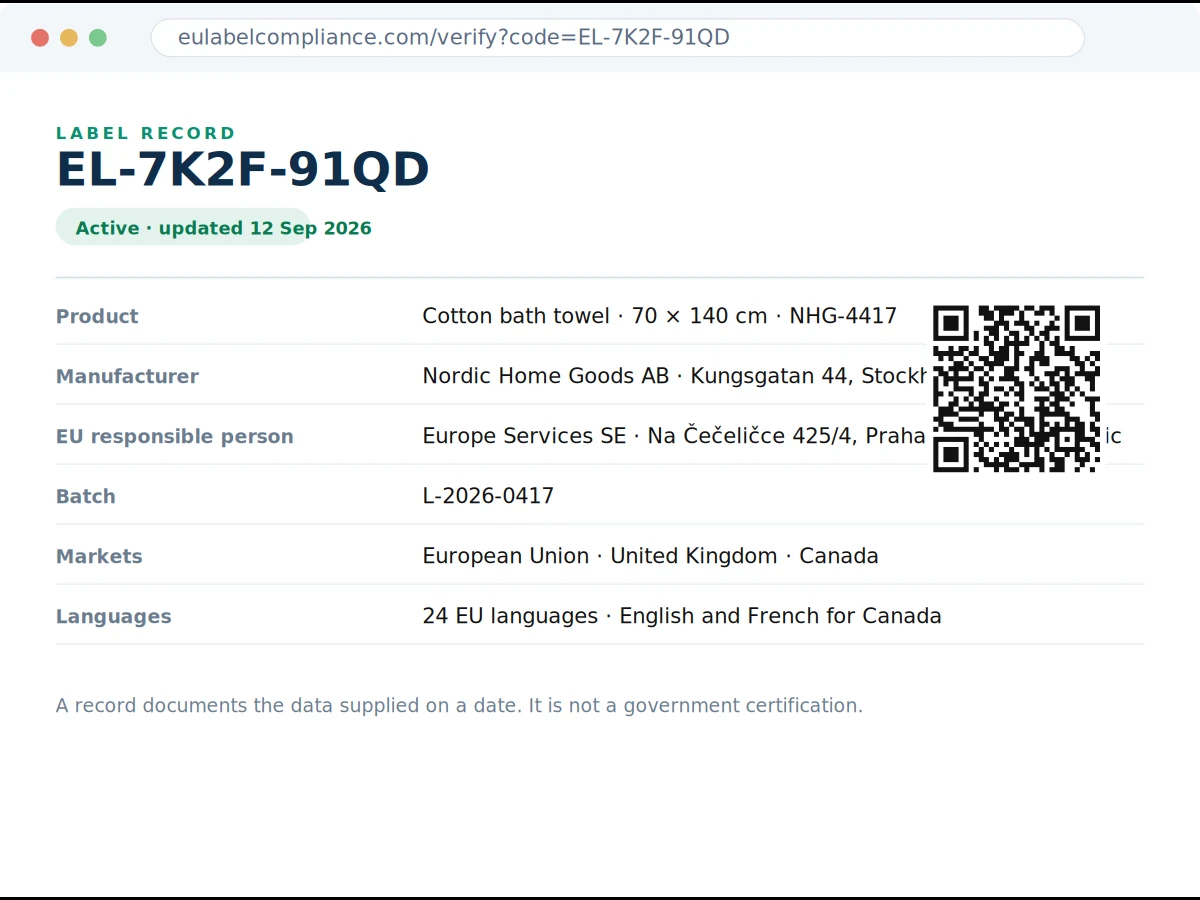
Under the GPSR a data carrier can complement the mandatory information. The manufacturer's identity, the responsible person, the batch and the warnings stay printed and legible on the product or its packaging.
The same is true for cosmetics today, and the direction of travel elsewhere — packaging, batteries, ecodesign — is towards digital carriers that add data rather than remove ink.
A printed label freezes information on the day of the print run. Addresses change, responsible persons change, warnings are added after a complaint. Every label already in circulation becomes wrong at once.
A permanent code printed beside the QR points at a record you can update. The scan shows today's data, dated, and the labels in the warehouse stay usable.
Only what legally has to appear on the label: manufacturer, responsible person, product identifier, warnings and the date of the last update. Not your account, your VAT number or your payment history.
It says plainly that it documents client-supplied data on a date and is not a government certification, because claiming otherwise would be a bigger risk than the problem it solves.
We place the QR at a size that survives a supermarket scanner and a worn label, with a quiet zone, and we print the code in human-readable characters underneath so it works when the print is damaged.
The packaging regulation introduces digital marking for packaging identification on its own timetable. The battery regulation brings a battery passport for certain categories. Ecodesign rules bring the digital product passport for others.
None of these removes the printed safety blocks. They add a machine-readable layer with its own data model and its own deadlines, and they will arrive category by category rather than all at once.
Print size, quiet zone, contrast and substrate decide whether a scan works after six months in a warehouse. A code printed too small on a curved surface fails at the first attempt, and consumers do not try twice.
We size the code for the label, keep the quiet zone clear and print the human-readable characters underneath, so a worn code is still usable by typing it.
Marketing pages, trackers and login walls. Where a data carrier carries regulated information it has to be accessible without an account, without an app and without collecting data about the person scanning.
Our record pages are plain, fast and public, and they say what they are: a dated statement of client-supplied data, not a certification.
| Framework | Carrier allowed | Replaces printed text? |
|---|---|---|
| GPSR | Yes, as a complement | No |
| Cosmetics 1223/2009 | Limited | No |
| Packaging (PPWR) | Required on its own timetable | Partly, for identification |
| Batteries | Battery passport for some categories | No, adds |
| Ecodesign (ESPR) | Digital product passport, by category | No, adds |
The same information, in the order an inspector or a reviewer meets it.
The code does not. The record stops resolving if the subscription ends, and we keep the data for thirty days.
Yes, for your own content. The compliance record needs its own code so that the data behind it is the data we maintain.
Not for the general product safety blocks. Packaging and several sector rules are moving that way with their own timetables.
No. The record pages set no profiling cookies and do not identify the person scanning.
No. One code per product is what makes the record meaningful.
The printed blocks still carry the mandatory information, which is exactly why the carrier complements them.
Print-ready artwork for the markets you sell in, a permanent code with a public record, and a free reissue whenever your details change. Seven days free, no card.
 EU Label Compliance