How we work
Everything on this site condensed into the sequence a proper verification occurs in. Execute it before the print run, not after the container departs.
Identify the markets where the product is actually sold, not the ones you aspire to. Each market has its own regulatory framework, and the most economical mistake is designing artwork for one and shipping to multiple.
Determine your category. Toys, electrical appliances, and cosmetics each impose additional requirements that a generic layout does not accommodate.
1. Manufacturer's legal name and complete postal address, not just a trademark.
2. An operator established within the market: EU responsible person, UK representative, US distributor, Canadian dealer, Australian supplier.
3. A type, batch, or serial number that identifies the production batch.
4. Warnings and safety information in all required languages, using legally approved wording.
5. Correctly proportioned category marks: CE, UKCA, crossed-out bin, age warning, care symbols, Prop 65.
6. Net quantity and units as mandated by the market, metric units first in Canada and Australia.
7. Legibility: minimum x-height, contrast, durability on the substrate.
8. A proof printed at 1:1 scale and reviewed on paper prior to production.
Maintain the declaration of conformity and the technical documentation accessible to the designated operator. Keep a copy of the artwork with its revision date. Update the record immediately if an address or warning changes, ensuring already printed labels remain accurate.
Correct the record first, reissue the artwork, then decide on the stock. Re-labelling is inexpensive compared to withdrawal, and authorities treat sellers who promptly rectify issues differently from those who contest them.
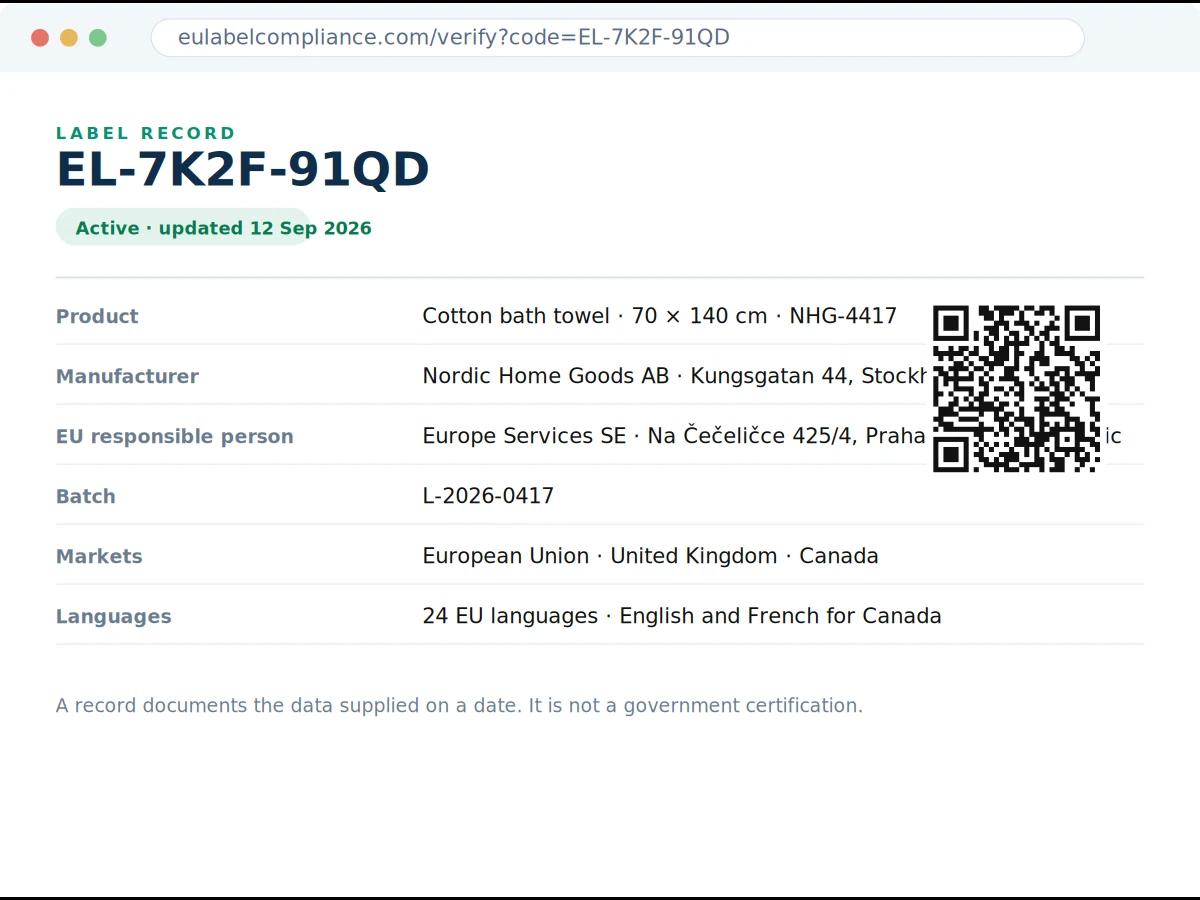
A cotton bath towel manufactured in Turkey, sold on Amazon in Germany, France, and Italy, plus a retail shop in the United Kingdom. Two markets, two packaging variants.
EU pack: manufacturer details, EU responsible person, batch number, fibre composition sewn in, care symbols, warnings in 24 languages on packaging, permanent code. UK pack: UK operator with a British address, English language, same composition and care instructions, same code.
Total artwork: two layouts plus an integrated label. One product record underlying both, so the manufacturer details are identical and updates propagate to all labels.
You provide the product data and compliance documentation. We prepare the artwork and maintain the public record. Your printer produces the labels. Your designated operator responds to authorities.
The most common failure mode is neglecting the third step: artwork approved but never printed on the correct substrate, resulting in stock with peeling labels.
Record the expiry date of the operator's mandate and schedule periodic reviews of the technical documentation. Update the record immediately when an address or warning changes. Keep the dated artwork with batch records to trace which label was applied to each production run.
| Step | Owner | Evidence to keep |
|---|---|---|
| Confirm markets and category | You | Written note in the file |
| Supply product and company data | You | Registration documents |
| Build artwork and record | Us | Dated files and the code |
| Approve the 1:1 proof | You | Signed proof |
| Print and apply | Your printer | Substrate specifications and production date |
| Respond to authorities | Designated operator | Correspondence and deadlines |
The same information, arranged in the sequence an inspector or reviewer encounters it.
The certification and the permanent code are immediate; the print-ready artwork is prepared within a few working hours.
Then you cannot label the product truthfully, and that is a supplier issue prior to labeling. We will inform you rather than fabricate a solution.
Yes. Send us the artwork or a photograph, and we will identify missing elements, block by block.
Unlimited. Plans are based on markets, not SKUs.
We can identify the regulatory blocks it contains. We do not provide opinions on other companies’ compliance status.
You still purchase one market subscription: the EU counts as one, so a seller in Germany alone pays the same as one selling across all 27 member states.
Print-ready artwork tailored to your markets, a permanent code with a public record, and a free reissue whenever your details change. Seven days free, no credit card required.
 EU Label Compliance