How we operate
A label can include all mandatory information and still fail, because the text is too small, the contrast too low or the file received by the printer was a screenshot.
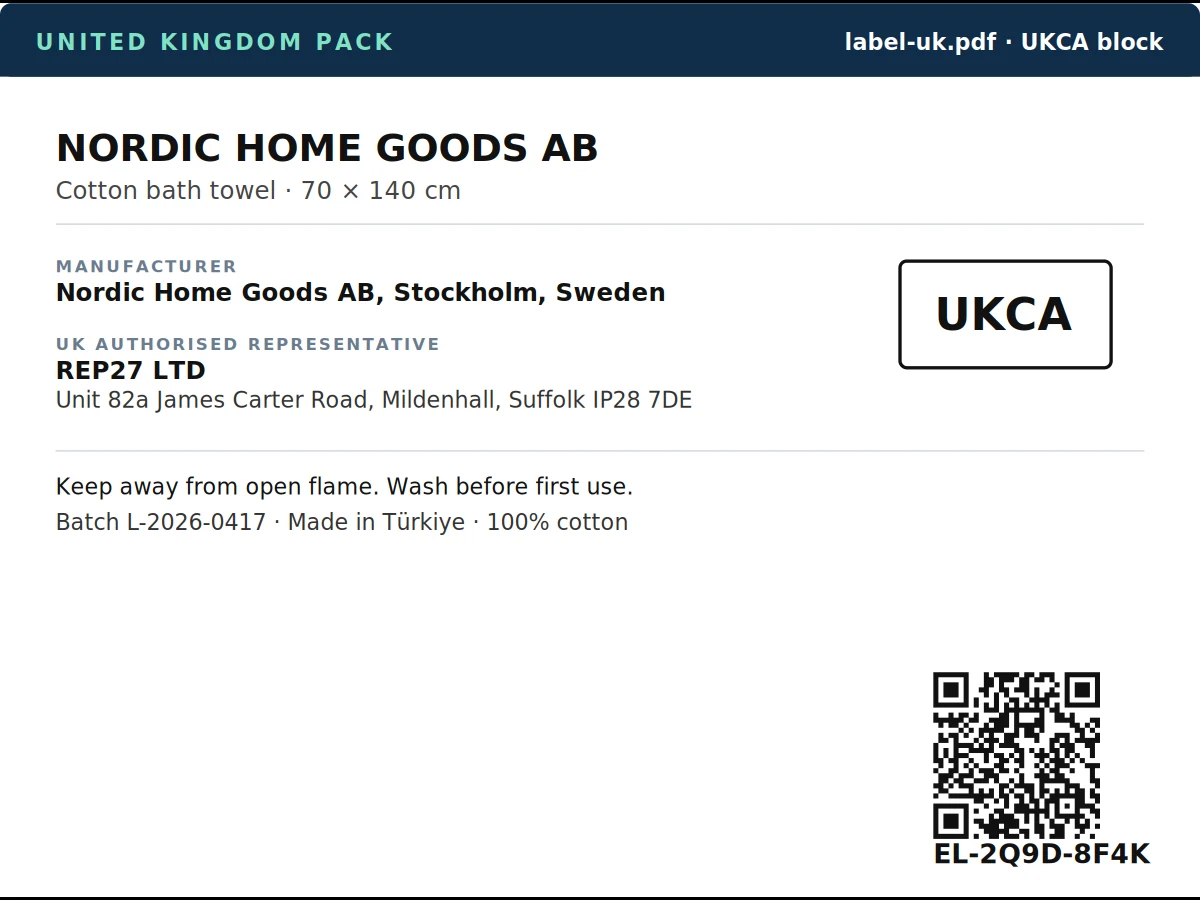
A print-ready PDF at 300 dpi in CMYK with 3 mm bleed and crop marks. An SVG with live text and vector pictograms, allowing a local studio to adjust without redrawing. A 1:1 PNG proof for approval and marketplace documentation.
If your printer requires a different colour profile, die-line or spot colour, send it to us and we will match it rather than asking you to modify your file.
There is no universal millimetre measurement applicable across all categories, but the information must be legible and indelible. We set safety text at a minimum of 1.2 mm x-height and never below, maintain contrast above the level where thermal printing begins to compromise letter clarity, and avoid reversed-out text for mandatory information.
Category-specific regulations override these standards where stricter — for example, net quantity on Canadian packaging, measurement markings in Australia, or font sizes specified in US display panel regulations.
Indelible means it remains legible during the normal lifespan of the product. A thermal receipt label on a product exposed to summer heat in a vehicle is not considered indelible, nor is an inkjet print on uncoated paper sewn into a garment. We flag mismatches when the category and substrate you specify are incompatible.
Print the 1:1 proof on paper at actual size, and verify the smallest text line from a normal viewing distance. This step prevents costly errors at the port.
Thermal transfer printing on synthetic films preserves fine text and withstands moisture. Direct thermal printing fades with heat and light and is unsuitable for information that must remain legible throughout the product’s life. Uncoated paper absorbs ink and closes small counters.
Fabric labels lose about one size step due to the weave; thus, a 1.2 mm x-height on paper becomes marginal on woven polyester, prompting us to set larger sizes.
Curved surfaces and shrink sleeves distort text and codes; artwork for these must be pre-distorted or the code may fail.
Mandatory text in light grey on white may pass screen review but fail during printing. We ensure mandatory blocks have full contrast and avoid reversed-out text unless justified by the substrate.
Spot colours are matched if provided; otherwise, we use a CMYK build that can withstand a four-colour print run without registration issues on small type.
The batch field is a designated zone with sufficient clearance, allowing a line printer or inkjet head to fill it without overprinting mandatory information. For in-house batch printing, we provide the zone coordinates.
| File | Format | Use |
|---|---|---|
| Print PDF | 300 dpi, CMYK, 3 mm bleed, crop marks | The print run |
| Vector SVG | Live text, vector pictograms | Local adjustments |
| Proof PNG | 1:1 at actual size | Approval and marketplace documentation |
| Zone map | Coordinates of the batch zone | In-house variable printing |
The same information, arranged in the order an inspector or reviewer encounters it.
Yes, most clients prefer that. Send us the file or a photograph, and we will recreate a compliant version within your design.
We match the die-line provided by your printer. We do not create structural packaging designs.
The batch zone is designed as a variable area so your printer or production line can fill it per batch.
Yes, send us the reference and substrate, and we will match accordingly.
We provide outlined vector fonts, so no licensing travels with the file.
We can export from the same vector source upon request.
Print-ready artwork for your target markets, a permanent code with a public record, and free reissuance whenever your details change. Seven days free, no credit card required.
 EU Label Compliance